
Your Business Isn't 'AI-Powered.' It's AI-Adjacent, and AI Due Diligence Will Expose It
Published on 29 July 2026 • Written by James Lawson
Why technology stack diligence and an honest AI readiness assessment matter more than any AI feature on your roadmap.
There are far too many SaaS businesses in Europe describing themselves as AI-powered. Very few of them are. The difference between genuine AI integration and a Claude wrapper dressed up in a product roadmap will become the defining exit risk for PE-backed software businesses over the next 24 months, once AI due diligence becomes standard practice.
There is a meaningful difference between a SaaS business that uses AI to deliver materially better outcomes for its customers, and a SaaS business that has added an AI feature to avoid looking behind the curve. The first group is building a moat. The second group is managing optics.
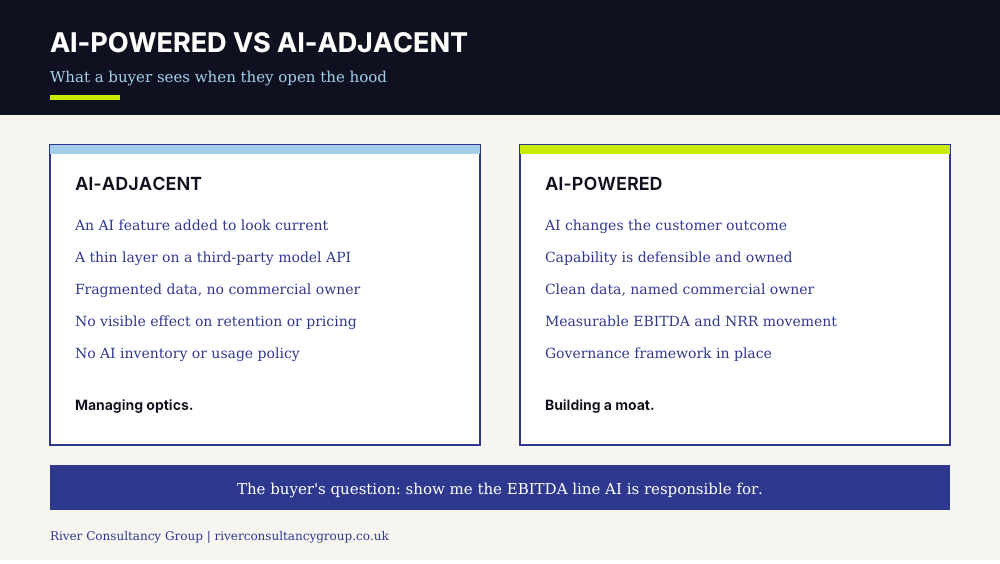
Right now, most PE-backed SaaS businesses sit in the second category. But at the point of exit, when a strategic buyer or growth equity firm is conducting technology stack diligence, the key question is not 'do you have an AI feature?' It's 'show me the EBITDA impact of your AI investment and explain why your AI capability is defensible.'
What buyers are already asking
This is not a prediction about a distant future. Grant Thornton's 2026 piece on what buyers are asking about AI sets out the questions in plain terms: is AI embedded in the product in a way that supports pricing power, retention and differentiation, or is it a standard feature customers expect anyway? Is it tied to measurable revenue growth? Can the company show clean data pipelines, clear data ownership, and where its AI outputs come from? How does it handle proprietary data with third-party models?
Law firms are framing it the same way. Mayer Brown's May 2026 note, AI: The Next Frontier of PE Deal Risk, warns that management may overstate its AI capabilities and tells buyers to test whether claimed differentiation is durable, "especially for thin integrations" on a foundation model provider's API. That is the Claude wrapper problem, written into a diligence checklist. It also flags that buyers should check whether a target could resist price rises, terms changes or API deprecation from its AI vendor, and that RWI carriers are starting to add AI-specific exclusions.
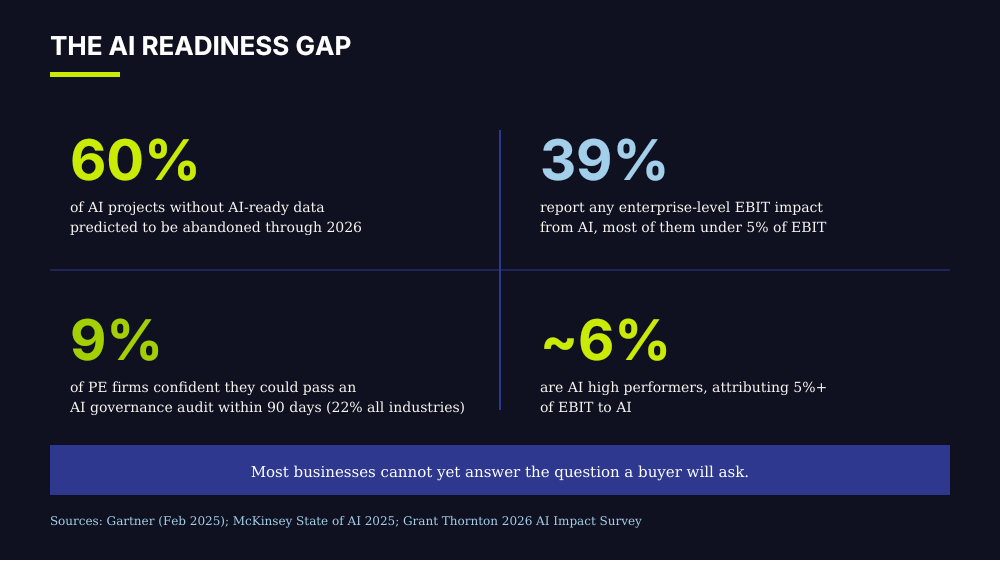
The preparation gap is large. In the same Grant Thornton piece, only 9% of private equity firms said they were confident they could pass an independent audit of their AI governance within 90 days, against 22% across all industries. If the investors are not ready for the question, their portfolio companies are further behind.
What a genuine AI readiness assessment means
AI readiness is not about having a roadmap with AI in it. It is about having the data infrastructure, the operational processes, the change-management capability, and the commercial model that allow AI to produce measurable business outcomes.
The businesses I have seen attempt AI transformation and fail almost always fail for the same reasons: fragmented data, use cases that create no visible customer value, implementation without a commercial owner, no governance framework, and change management treated as a communication exercise.
The wider evidence points the same way. Gartner predicts that through 2026 organisations will abandon 60% of AI projects that lack AI-ready data, and its survey found 63% of organisations either lack the right data management practices for AI or are unsure whether they have them. McKinsey's State of AI 2025 survey of 1,993 respondents found that 39% report any enterprise-level EBIT impact from AI, and most of those say less than 5% of EBIT is attributable to it. Only around 6% qualified as high performers. And MIT's NANDA report, The GenAI Divide, found about 95% of enterprise generative AI pilots delivered no measurable P&L impact, with tools bought from specialised vendors succeeding about 67% of the time, against roughly a third of that for internal builds. That 95% measures pilots without rapid revenue or P&L impact, not a general failure rate, and the sample is modest, so treat it as a directional signal.
"The question a buyer will ask in the next year is not 'do you have AI?' It is 'show me the EBITDA line that AI is responsible for.' Most businesses cannot answer that yet."
5 AI use cases that make the boat go faster
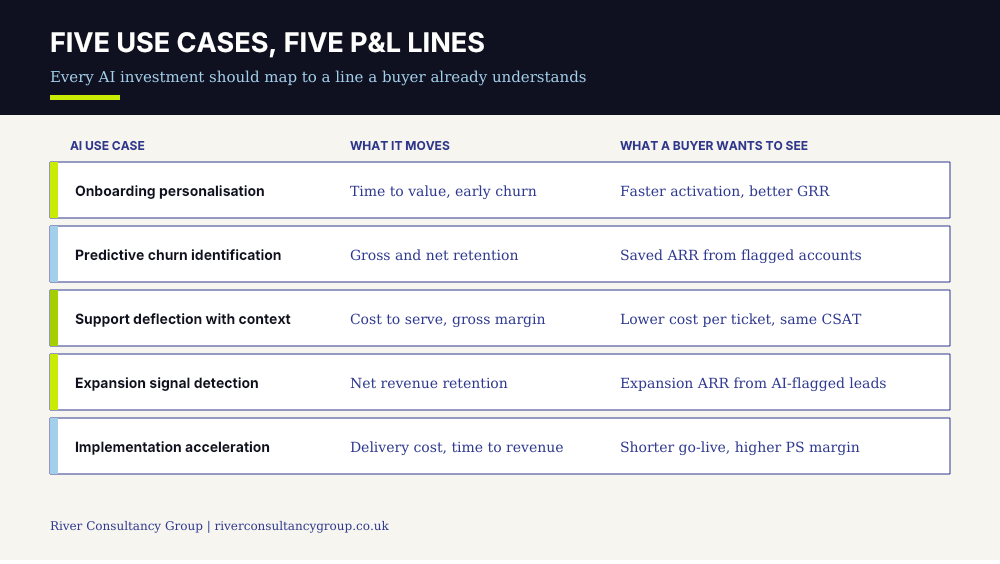
Automated onboarding personalisation. Predictive churn identification. Support deflection with context. Expansion signal detection. Implementation delivery acceleration.
Each of these earns its place for the same reason: it maps to a line a buyer already understands. Onboarding personalisation and implementation acceleration shorten time to value and protect early retention. Churn identification and expansion signal detection move net revenue retention, the number that sits behind exit multiples. Support deflection with context takes cost out without degrading the customer experience. The test for every one is the same: name the owner, name the metric, and show the movement in the P&L. If you cannot do that, it is a feature, not a capability.
The awkward AI governance conversation before technology stack diligence begins
If your product processes personal data, operates in financial services, healthcare, legal, or HR, or operates across multiple European jurisdictions, your AI capability needs a governance framework now, not at the point when a regulator asks for one, or when a buyer's AI due diligence team asks for one.
The regulatory picture has shifted but not softened. Under the EU's Digital Omnibus, which entered into force on 27 July 2026, the high-risk AI obligations for stand-alone systems moved from August 2026 to 2 December 2027, and obligations for AI embedded in regulated products moved to 2 August 2028. The Article 50 transparency obligations were not deferred and apply from August 2026. A longer runway is not a reason to wait. The deadline binds the company, but the buyer's diligence clock starts at the next transaction, and a business with no AI inventory, no usage policy and no record of what data has passed through third-party models will be asked to explain why. Mayer Brown also notes that "shadow AI", the informal and unapproved use of tools by staff, is likely to be a defining diligence issue.
If you would like to talk more about how we have helped others prepare for AI due diligence and navigate their business to real AI value please reach out to myself jameslawson@riverconsultancygroup.co.uk or my partner denny.burda@riverconsultancygroup.co.uk or explore more on our website riverconsultancygroup.co.uk
James Lawson is founder of River Consultancy Group. He has led AI-assisted operational transformation inside PE-backed SaaS businesses, reducing cost of acquisition by 59% and generating £6M in new business revenue through customer-led growth methodologies. Connect: linkedin.com/in/jlaw-maketheboatgofaster
Sources referenced:
