
The Dropped Baton: Why SaaS Growth Stalls in the Handoff, Not the Sprint
A revenue operations framework for founder-led and PE-backed SaaS teams who are ready to stop losing ground they already won.
Most SaaS companies don't lose the growth race because any one team ran slowly. Sales hits pipeline targets. Marketing hits MQL targets. CS hits renewal targets. Individually, everyone crossed their leg of the race in good time. And yet the company as a whole finishes slower than the sum of its parts suggested it should.
The Relay Exercise: A Lesson in Execution Gaps for SaaS Revenue Teams
Picture a relay race. Four strong runners, each fast enough to win their leg outright. But a relay isn't won or lost in the running. It's won or lost in the handoff, the two seconds where one runner passes the baton to the next.
Watch enough relay teams and you'll see it: the runner slows too early, or the next runner starts too late, or nobody rehearsed the exchange because everyone assumed the other side had it covered. The baton hits the track. The race is over, regardless of how fast either runner was individually.
At some point speed isn't enough. You have to ask: where exactly is the baton being dropped?
Where Are the Handoffs Breaking in Your Revenue Engine?
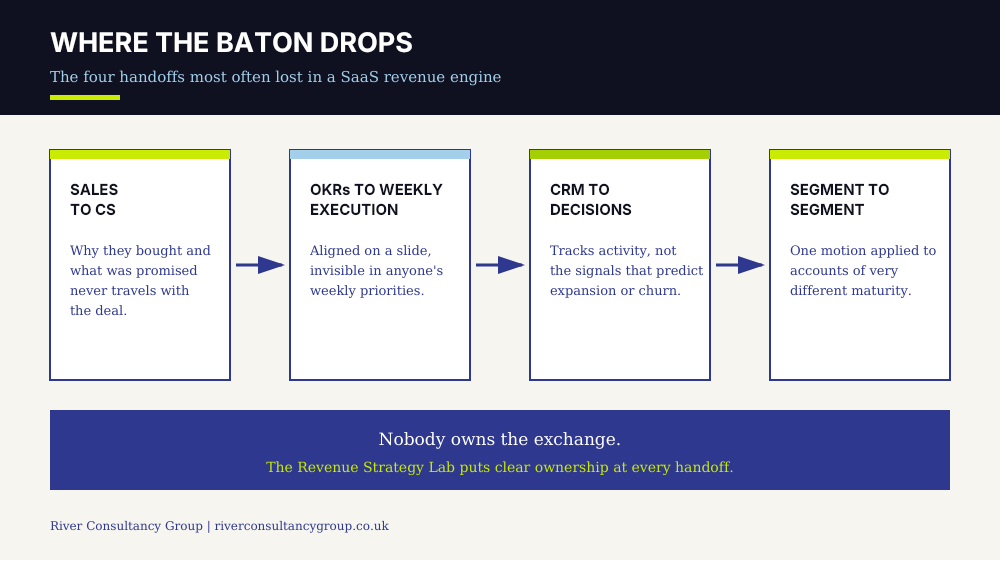
At River, we've spent years embedded inside revenue teams as fractional CROs and growth leaders, building the diagnostic behind the Revenue Strategy Lab. The pattern repeats across founder-led and PE-backed SaaS businesses alike. The handoffs most commonly dropping the baton:
Sales to CS. The deal closes, but context on why the customer bought, what they were promised, and what success looks like doesn't travel with it. Gartner's research on B2B buying found that 77% of buyers describe their most recent purchase as complex or difficult. A buyer who found the purchase hard and then meets an onboarding experience nobody prepared them for doesn't give the benefit of the doubt. CS starts the relationship a lap behind, and the customer notices. The cost lands later, in the renewal, which is why this handoff is one of the first places we look in a SaaS Growth Audit.
OKRs to weekly execution. Leadership sets quarterly OKRs that look aligned on a slide. Three levels down, no individual's weekly priorities actually reflect them. This is one of the best documented gaps in management research. Robert Kaplan and Andrew Pateman, writing for Harvard Business School's Working Knowledge on the work he did with David Norton, reported that around 95% of employees in most organisations do not understand their organisation's strategy, that 60% of organisations do not link strategic priorities to their budget, and that the compensation of over 90% of front-line employees is not linked to strategy. If the budget, the incentive and the weekly priority all point somewhere else, the OKR was never handed off. It was only announced.
CRM to decision-making. The system captures activity, but not the handful of signals that predict expansion or churn, so the data that should trigger the next handoff never fires. Much of the problem is simple capacity. Salesforce's State of Sales research, as summarised by Advisorpedia, found reps spend only around 34% of their week selling, with the rest going on admin such as CRM data entry, research and meeting prep. The same summary notes that up to 30% of CRM data quality erodes within a year. A system fed by overloaded reps and decaying records cannot flag the account that is about to churn or expand.
Segment to segment. A single go-to-market motion gets applied uniformly across territories and account tiers with very different maturity, and the handoff between "how we sell" and "how we should sell to this account" never happens. SaaS Capital's retention research shows retention varies materially with contract value, and that higher ACVs correlate with higher net retention. One motion cannot serve a $30K account and a $300K account equally well, and the data says the economics of each are different.
Most SaaS companies don't fail because any function underperforms. They fail because the baton drops between functions, and nobody owns the exchange.
Why Good Plans Still Fail at the Exchange
The pattern behind all four drops is the same: plans are well made and poorly transferred. A Bain study of 1,854 large companies, cited in the same Kaplan and Pateman piece, found that seven out of eight failed to achieve profitable growth, even though more than 90% of them had detailed strategic plans with ambitious targets. The plan was not the weak point. The weak point was getting it from the people who wrote it to the people who run the week.
That is why more sprinting rarely helps. A faster Sales team hands over more poorly briefed customers. A sharper OKR deck widens the gap between what leadership says and what the team does on Monday. Speed is the wrong lever when the loss happens in the exchange.
What the Data Says About the Cost of a Dropped Baton
This isn't just an operating theory. It shows up directly in the retention numbers that determine SaaS valuations.
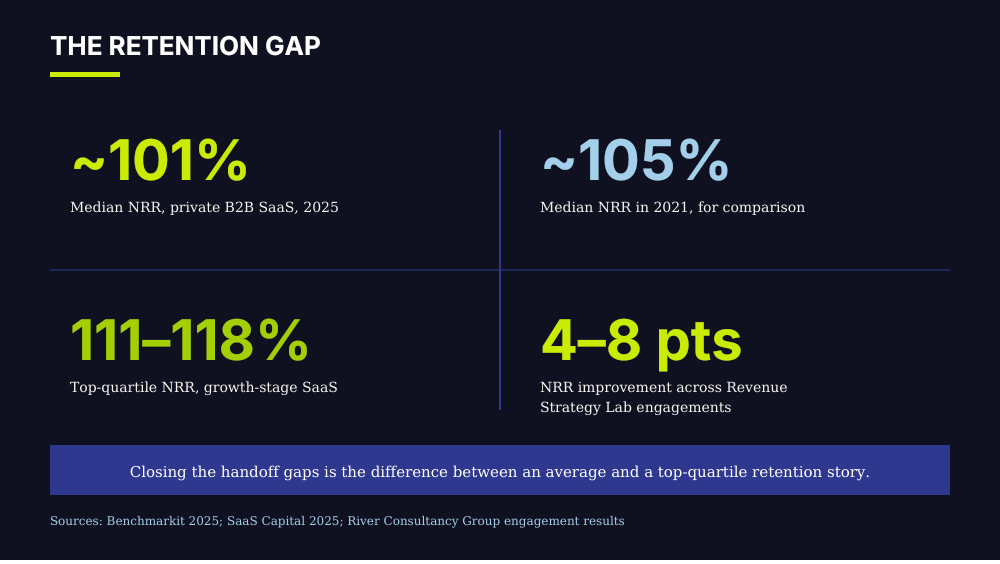
Benchmarkit's 2025 SaaS Performance Metrics report puts median Net Revenue Retention for private B2B SaaS at around 101%, down from roughly 105% in 2021, with median gross retention sliding to about 88%. SaaS Capital's 2025 retention benchmarking research found a similar picture for growth-stage companies: median NRR in the low 100s depending on ACV tier, with top-quartile companies reaching 111% and above. In both datasets, the gap between median and best-in-class performers tracks closely with how well a company runs its cross-functional handoffs. That last link is our operating observation from client work, not a finding either report makes.
That gap is not a rounding error to investors. Software Equity Group's analysis of its public SaaS index found that, in its 2Q24 data, companies with NRR above 120% traded at a median 9.3x EV/revenue, roughly a 63% premium to the index median, while companies below 100% NRR traded at just 3.1x, a 46% discount. Public multiples have since compressed, with SEG's 2Q26 report putting the index median at 3.2x. The absolute multiples have moved, but the ordering has not: retention, not new-logo growth, is the number doing the most work in that multiple, which is exactly why PE operating partners scrutinise it first in diligence.
Most SaaS companies don't lose the multiple because they stopped acquiring customers. They lose it because the revenue they already earned is leaking out through gaps nobody owns.
Fixing Growth Means Fixing the Exchange, Not Running Faster
Revenue is a relay, not four separate sprints. Sustainable growth requires the handoffs between Sales, Marketing, Customer Success, Product, and Executive Leadership to be as deliberately built as any individual team's playbook. In practice that means four disciplines:
Name an owner for every handoff. Not a team, a person, with a definition of what "handed over" means.
Carry the buying context forward. Why they bought, what was promised and what success looks like travels with the deal into CS.
Cascade the OKR into the week. Budget, incentive and weekly priority all point at the same objective.
Instrument the signals that matter. A short list of predictive expansion and churn signals, kept clean, beats a CRM full of activity.
The Revenue Strategy Lab: Rebuilding the Handoffs Between Revenue Teams
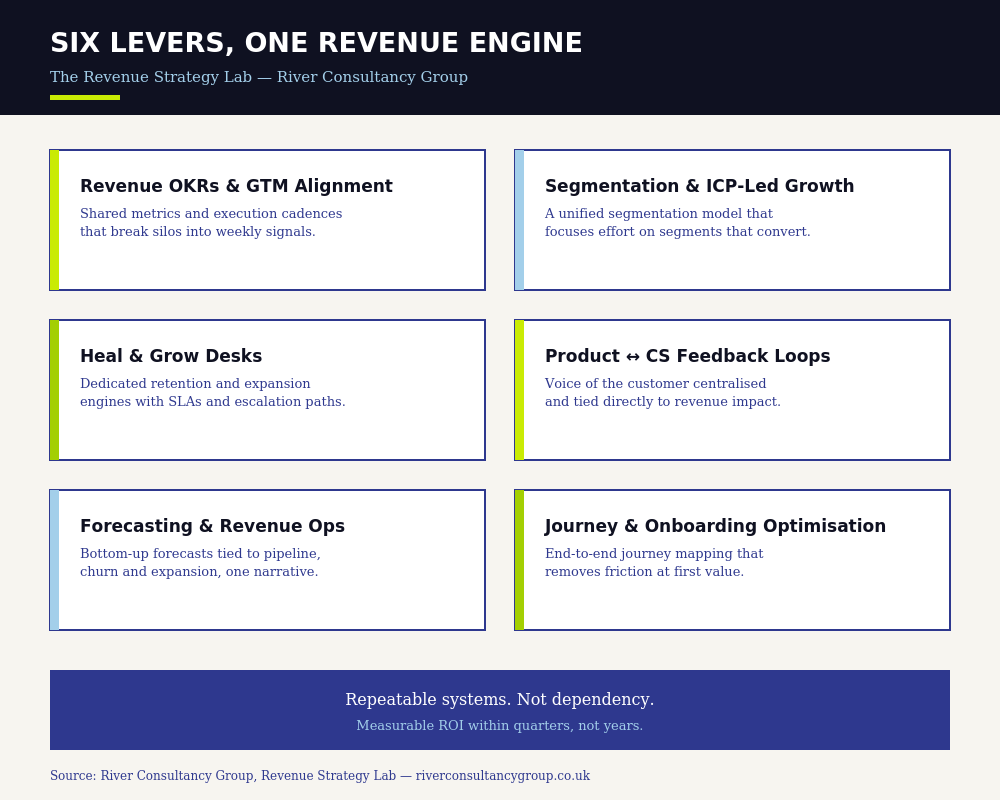
The Revenue Strategy Lab, our flagship methodology, is what we apply as embedded Fractional Growth Partners to close these gaps: revenue-driving OKRs that cascade into weekly execution, CRM and systems discipline that surfaces the signals that matter, and clear ownership at every handoff between teams.
Across Revenue Strategy Lab engagements, companies have achieved 10 to 25% ARR growth and 4 to 8 point improvements in Net Revenue Retention, not from replacing any single team, but from closing the gaps between them. Set against a market median NRR of roughly 101%, a 4 to 8 point gain is the difference between an average retention story and a top-quartile one, the kind of result PE operating partners want to see repeated across every portfolio asset.
If you'd like to talk about where your revenue engine might be dropping the baton, reach out to me at denny.burda@riverconsultancygroup.co.uk or my partner James at jameslawson@riverconsultancygroup.co.uk, or explore more at riverconsultancygroup.co.uk.
Denny Burda is CCO of River Consultancy Group and creator of the Revenue Strategy Lab. He has led revenue teams to sustained growth across founder-led and PE-backed SaaS businesses. Connect with Denny at linkedin.com/in/dennyburda.
