
What Investors Really Think of Customer Sentiment
Why your customer health score matters less than the SaaS valuation metric buyers actually price: net revenue retention.
Net Promoter Score once dominated SaaS customer health conversations for over fifteen years. Most businesses report it, few understand it, and almost none use it correctly. Here is what predicts revenue and why the best equity-backed SaaS businesses have already moved on from wasting investors' time with vanity metrics.
I have turned an NPS score from −75 to +38 in seven months. And yet, when I presented those numbers to the board, the first question was: 'Great James, but what happened to renewal rates?'
Can you handle the truth about your customer health score?
However you survey your customers, an NPS survey tells you how a customer feels about your product at a single moment in time. It doesn't tell you if they will renew or expand.
"A satisfied customer who never uses your product is not a success story. It is a churn risk that hasn't been triggered yet."
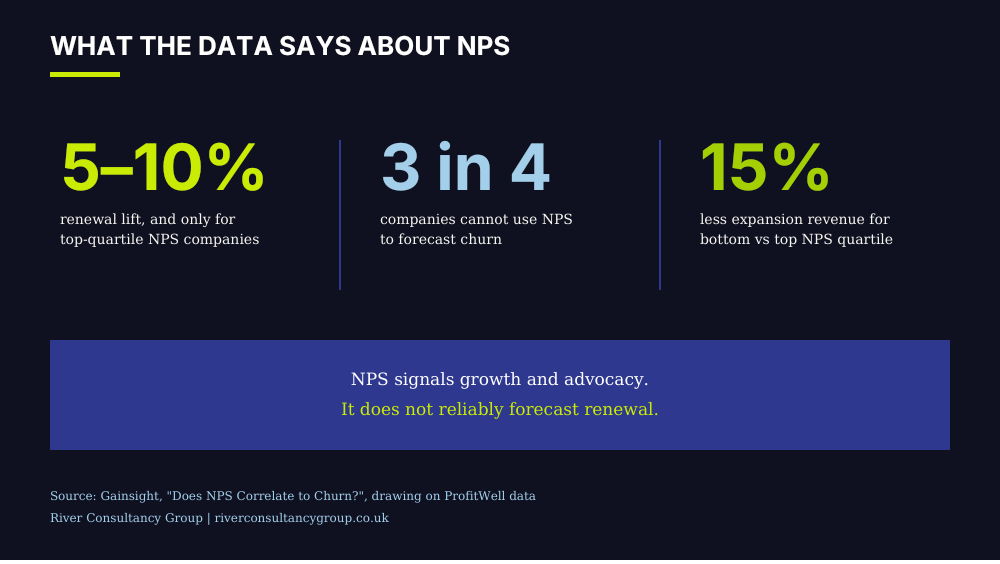
This is not a fringe view. Gainsight, a company that has built its business on customer health, reviewed ProfitWell's data and found no consistent relationship between NPS and renewal for most companies. Only businesses in the top quartile of NPS for their vertical saw a modest 5 to 10% lift in renewals, which means roughly three in four companies cannot use NPS to forecast churn. Source: Gainsight, "Does NPS Correlate to Churn?"
The reasons promoters still leave are operational: the champion moves on, the customer likes you but never reaches the outcome they bought for, budgets shift, or the company gets acquired. None of those show up in a survey score.
NPS is not useless. The same data tied it to expansion: companies in the bottom NPS quartile earned about 5% less monthly expansion revenue than the median and 15% less than the top quartile. Treat it as a signal of advocacy and growth potential, not a renewal forecast.
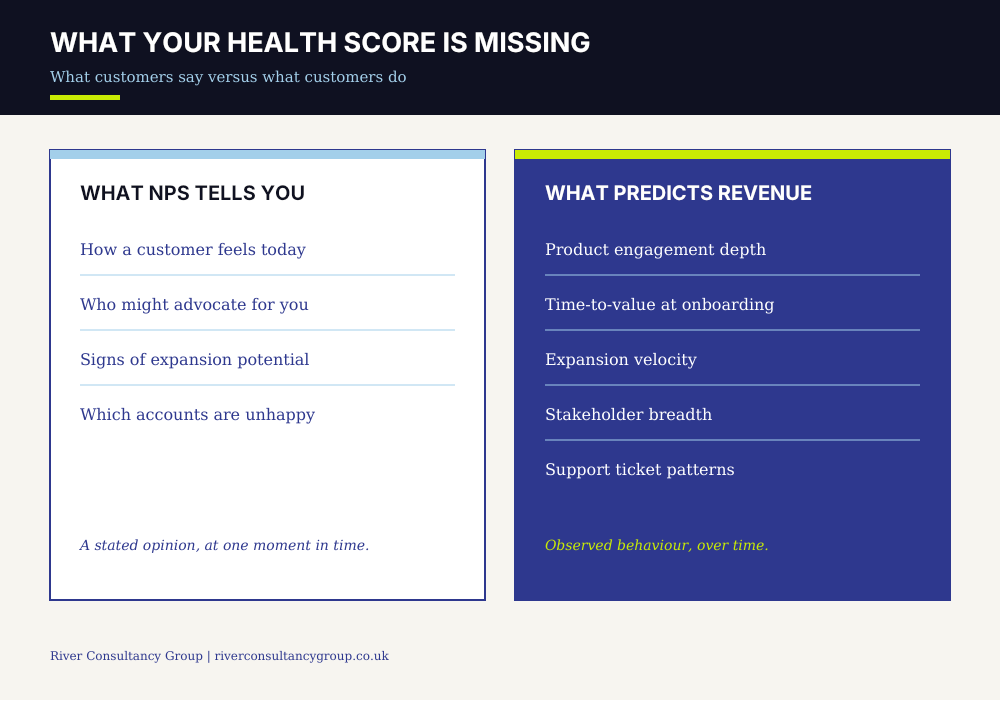
The metrics that predict revenue
Product engagement depth. Time-to-value at onboarding, the single most underrated metric in SaaS. Expansion velocity. Stakeholder breadth, or 'being multi-threaded'. Support ticket patterns.
Product engagement depth. Breadth of usage beats a warm score. When Gainsight analysed which signals predicted renewal across its own customer base, breadth of feature usage was one of the leading indicators, while NPS was a weak one. It is one company's data, but it points the right way. Source: Gainsight, "Our Top Indicators of Renewal"
Time-to-value. OnRamp's 2025 survey of 161 customer success and onboarding leaders found that nearly half of customers abandon onboarding if they do not see value quickly, and that 57% of companies that cut onboarding investment saw churn rise within six months. Source: OnRamp, "The First 90 Days"
Stakeholder breadth. Gartner puts the typical buying group for a complex B2B purchase at 6 to 10 people. If your relationship runs through one champion, you hold a fraction of the account, and a single resignation can end it. A departing champion is on Gainsight's own list of reasons promoters churn. Source: Gartner buying group research, as cited by Sendspark
Expansion velocity and support ticket patterns. These are the two I would add to any health score first, because both measure what customers do rather than what they say.
The SaaS valuation metric that actually matters
Net Revenue Retention is the number that matters. An NRR above 110% means your existing customer base is growing. An NRR below 90% means you are running to stand still, regardless of what your customer health score says.
For context, Benchmarkit's 2025 data puts median NRR for private B2B SaaS at about 101%, so 110% is a genuine differentiator, not table stakes. Source: Benchmarkit, 2025 B2B SaaS Performance Metrics Investors already speak this language. Software Equity Group reports that 67% of companies in its public SaaS index disclose NRR, making it the most commonly shared retention metric among public software companies. Source: Software Equity Group
Why this matters for equity-backed SaaS businesses specifically
If you are an equity-backed SaaS business, customer health is not a satisfaction metric. It is a SaaS valuation metric. Businesses with NRR above 110% command meaningfully higher multiples at exit.
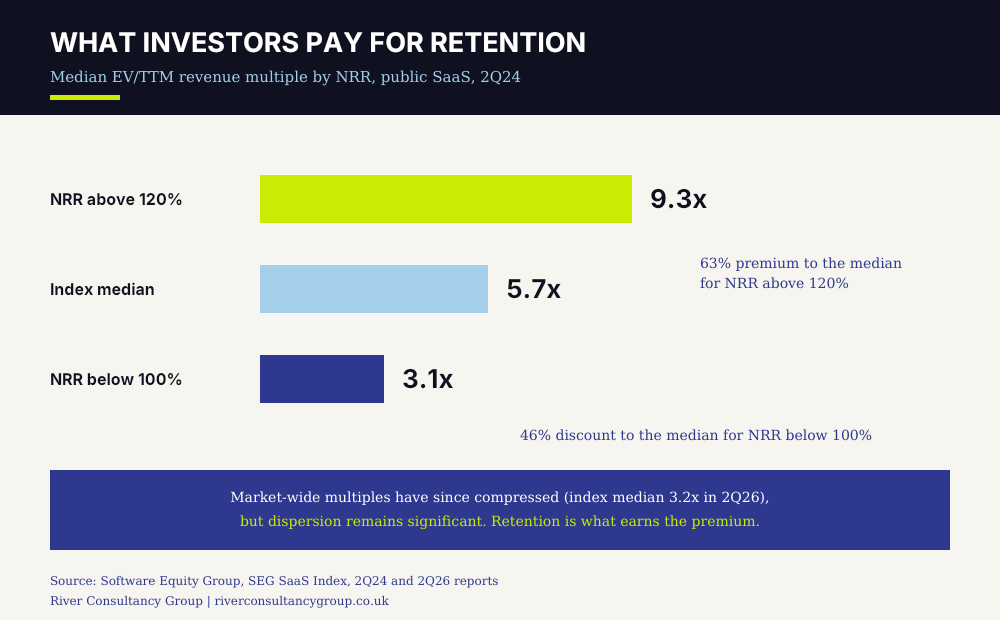
The evidence is consistent. In Software Equity Group's 2Q24 analysis, public SaaS companies with NRR above 120% traded at a median 9.3x EV/TTM revenue, a 63% premium to the index median, while those below 100% traded at 3.1x, a 46% discount. Multiples across the market have compressed since: SEG's 2Q26 report puts the index median at 3.2x. But SEG also notes that valuation dispersion remains significant, with premiums reserved for companies that pair strong operating performance with defensible advantages. Retention is the clearest evidence a buyer can underwrite that a business has both. Source: Software Equity Group, 2Q26 SaaS M&A and Public Market Report
Changing perspective
What I've seen work extremely well is moving from an NPS-centric view of customer health to a revenue-predictive model: better data, better conversation quality across Sales, CS, Marketing and Product, and a clear ownership model for growth revenue.
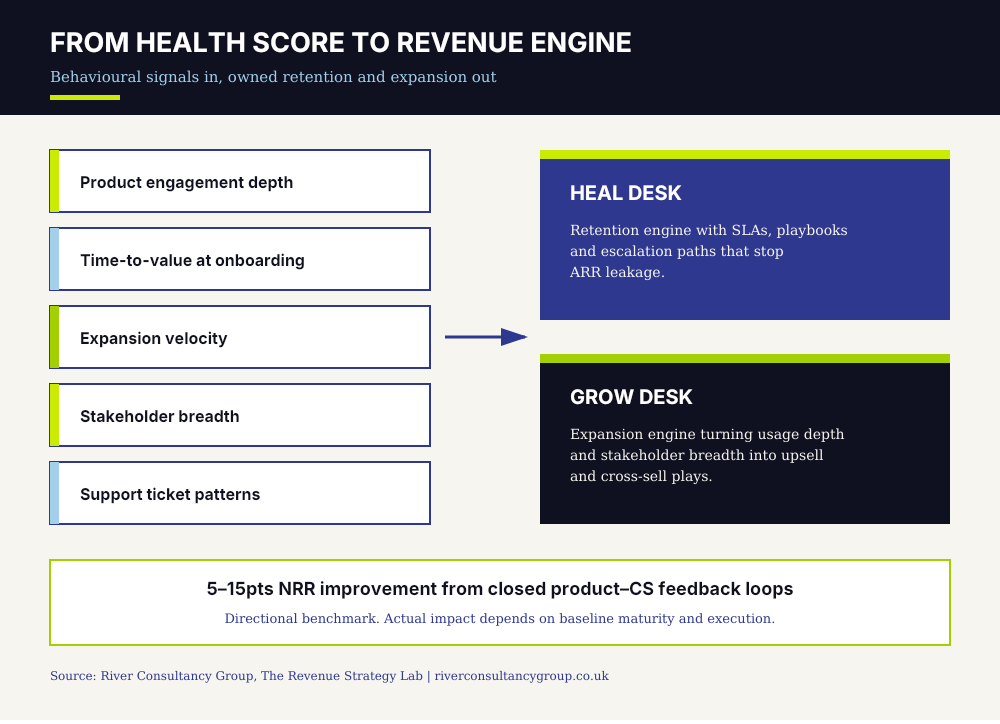
In practice that means three things. First, put behaviour into the score: usage depth, time to first value, stakeholder coverage, expansion velocity and ticket patterns. Second, back-test it. Take your last four to six renewal cycles and check which signals separated the accounts that renewed and expanded from those that did not, then drop any that have not earned their place. It is the same exercise Gainsight ran on its own customer base. Third, give one person ownership of growth revenue, so that when a score turns amber someone is accountable for the next move.
The Revenue Strategy Lab's Heal and Grow desks are built for exactly this: dedicated retention and expansion engines with clear SLAs, playbooks and escalation paths.
We at River have built some amazing pieces together with top equity partners and boards to help companies build the right customer health score and get their SaaS valuation metric story right. Want to know more? Please reach out to myself jameslawson@riverconsultancygroup.co.uk or my partner denny.burda@riverconsultancygroup.co.uk or explore more on our website riverconsultancygroup.com
James Lawson is founder of River Consultancy Group. He has managed customer portfolios totalling over $220M ARR across Oracle, Litera, Acquia, and Service Geeni, and is a recognised expert in post-sales across Europe. Connect: linkedin.com/in/jlaw-maketheboatgofaster
Sources referenced:
Gainsight, "Does NPS Correlate to Churn?" (drawing on ProfitWell data)
OnRamp, "The First 90 Days: Why Customer Onboarding Is the New Battleground for Customer Retention"
Gartner buying group research, as cited by Sendspark (secondary, verify against Gartner)
Software Equity Group, 2Q26 SaaS M&A and Public Market Report
