
Holes in the Bucket: The Hidden Revenue Leaks Killing SaaS Growth And Why Hypergrowth Eventually Stalls
Published on 17 June 2026 • Written by Denny Burda
A revenue operations framework for PE-backed SaaS and portfolio company growth teams who are ready to stop patching leaks and start plugging them.
Most SaaS companies experiencing rapid growth assume their current growth trajectory will continue into the next quarter and beyond. The challenge is that even the best SaaS growth strategy eventually breaks down when revenue leakage, rising acquisition costs, and customer churn begin to outpace growth. Many years ago in my youth I worked as a summer camp counselor. One of my favorite team building activities was simply something we called buckets. It was a team exercise then and one I still use on revenue operations trainings and retreats today.
The Bucket Exercise: A Lesson in Revenue Leakage for PE-backed SaaS
In a large field you have three buckets, each with a hole in it. The goal is simple: fill the big bucket as fast as you can. Eventually someone notices… the big bucket isn't filling up. It has tons and tons of holes in it.
"At some point momentum isn't enough and everyone stops the game. You now have to answer, is it possible to fill the big bucket at the end?"
What Are the Biggest Revenue Operations Leaks in Your SaaS Business?
At River, I spent over a year speaking with CROs, Revenue Operations leaders, Customer Success executives, and SaaS founders while developing the Revenue Strategy Lab. The most common metrics that are actually holes in your revenue operations:
Net Revenue Retention (NRR) is being reported incorrectly, often masking churn with expansion from a small number of very large accounts. Best-in-class SaaS businesses typically maintain NRR above 110%, while elite performers often exceed 120%.
Customer Acquisition Cost (CAC) has stayed the same or gone up from your growth push phase.
MQLs and SQLs are high but conversion rates are going lower.
Quota per rep. Blanket quota assignments often ignore territory maturity, customer segmentation, and go-to-market strategy.
"Most SaaS companies don't fail because they stop acquiring customers. They fail because revenue leaks compound faster than growth."
What's Actually Causing the Leak
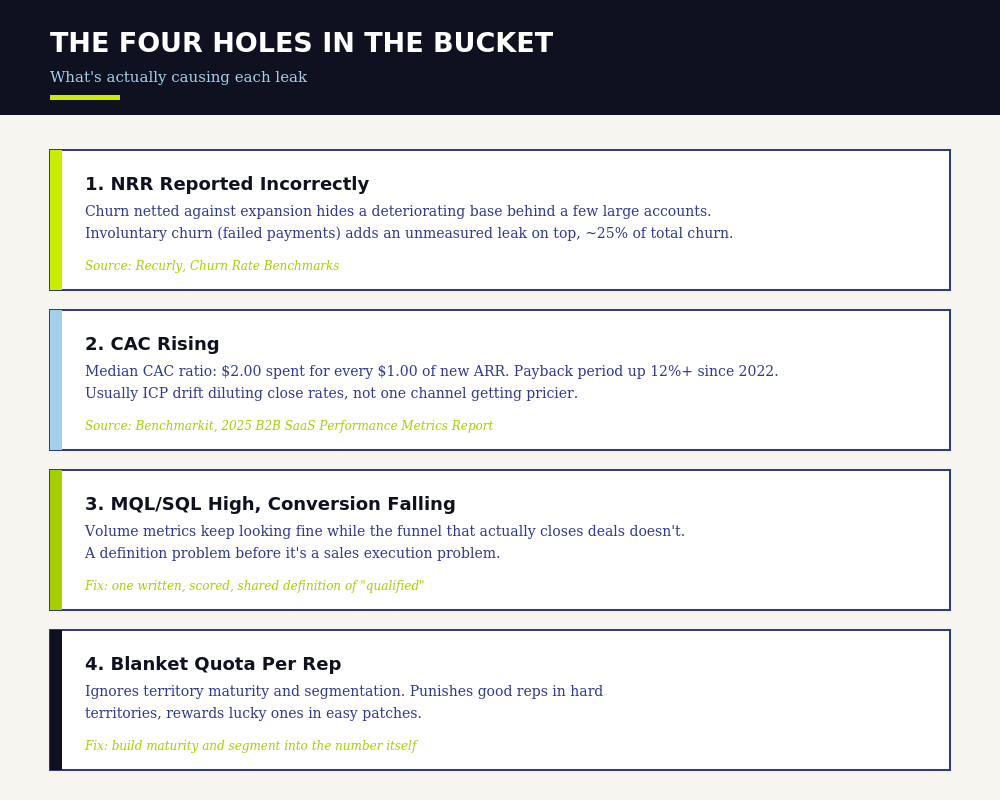
Each of those four holes has a specific, identifiable cause, not a vague "the market got harder" explanation.
NRR gets reported incorrectly most often because churn is being netted against expansion at the account level rather than examined separately. A blended number that looks healthy can hide the fact that a handful of large accounts are propping up the average while the rest of the base quietly deteriorates. There's also a mechanical leak most teams never separate out: involuntary churn, subscriptions lost to failed payments rather than a customer actually deciding to leave. Recurly's benchmark data, drawn from billions of dollars in subscription revenue processed on its platform, puts involuntary churn at roughly a quarter of total churn across SaaS businesses, and it's the most fixable kind because the customer never intended to go. Source
CAC rises for reasons that are usually structural, not seasonal. Benchmarkit's 2025 data found that new customer CAC ratio reached a median of $2.00 of sales and marketing spend for every $1.00 of new customer ARR, and that CAC payback period has increased by more than 12% since 2022. That's rarely one channel getting more expensive. It's usually ICP drift diluting close rates, or a sales motion built for an earlier, cheaper acquisition environment still running unchanged. Source
MQL and SQL volume staying high while conversion drops is almost always a definition problem before it's a sales execution problem. When marketing and sales silently drift toward different definitions of a qualified lead, volume metrics keep looking fine right up until the funnel that actually closes deals doesn't.
Blanket quota per rep ignores that not all pipeline is equally winnable. A rep assigned a mature, saturated territory and a rep assigned a greenfield segment are being measured against the same number despite radically different paths to it, which quietly punishes good reps in hard territories and rewards lucky ones in easy patches.
Why Churn Doesn't Just Subtract From Growth, It Compounds Against It
This is the part most growth teams underestimate. Churn isn't a flat tax on revenue. It's a compounding force that gets more expensive to overcome as the business gets bigger.
David Skok's widely cited modelling on this, built over years advising SaaS companies, shows why: as the subscription base grows, even a constant churn rate represents an ever-larger absolute dollar loss each month, which means new bookings have to work harder and harder just to keep growth flat, before they can contribute to actual growth at all. Skok's models show that a company generating negative churn, where expansion revenue from existing accounts exceeds revenue lost to churn, can end up nearly three times larger over five years than an otherwise identical company carrying a modest 2.5% monthly churn rate. Source This is the leaky bucket in numbers: the hole doesn't just slow you down, it actively works against every dollar of new growth you add.
What This Does to Your P&L
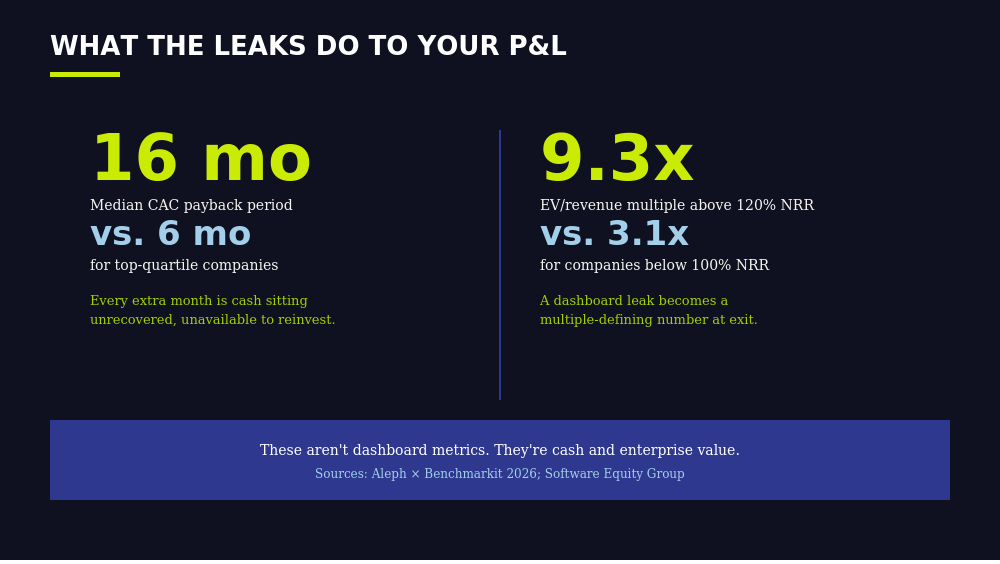
These aren't just operating metrics sitting on a dashboard. Each leak has a direct line to cash and to enterprise value.
A rising CAC payback period is a cash flow problem before it's anything else. The 2026 Aleph × Benchmarkit SaaS & AI Performance Benchmarks, covering 342 SaaS and AI-native companies, found the median B2B SaaS company now takes 16 months to recover its CAC, against 6 months for top-quartile companies. Every month added to that payback window is a month of sales and marketing spend sitting on the balance sheet as unrecovered cash, capital that isn't available to reinvest in the next round of growth. Source
NRR has an even more direct line to valuation. Software Equity Group's analysis of public SaaS companies found that businesses above 120% NRR traded at a median 9.3x EV/revenue, against 3.1x for companies below 100%. A leak that looks like a few percentage points on an internal dashboard is, at the point of a raise or an exit, a multiple-defining number. Source
Revenue Growth Requires Fixing Leaks, Not Just Adding More Customers
In business, revenue is a team sport. Sustainable revenue growth requires cross-functional alignment between Sales, Marketing, Customer Success, Product, and Executive Leadership.
How to Actually Close These Leaks
Fixing each of the four starts with treating them as distinct problems, not one generic "improve retention" initiative.
For NRR, separate voluntary churn from involuntary churn before you diagnose anything else, and put dunning and payment recovery infrastructure in place for the involuntary share, since it's the fastest, cheapest win available. For the voluntary share, look at account-level trends rather than the blended average.
For CAC, the fix is rarely "spend less." It's usually re-tightening ICP so acquisition spend is pointed at accounts with a real path to expansion, not just a real path to closing.
For MQL-to-SQL conversion, get Sales and Marketing working from one written, scored definition of qualified, reviewed on a set cadence, not whatever definition each function quietly drifted toward.
For quota, build territory and segment maturity into the number itself, rather than assigning the same target to fundamentally different starting positions.
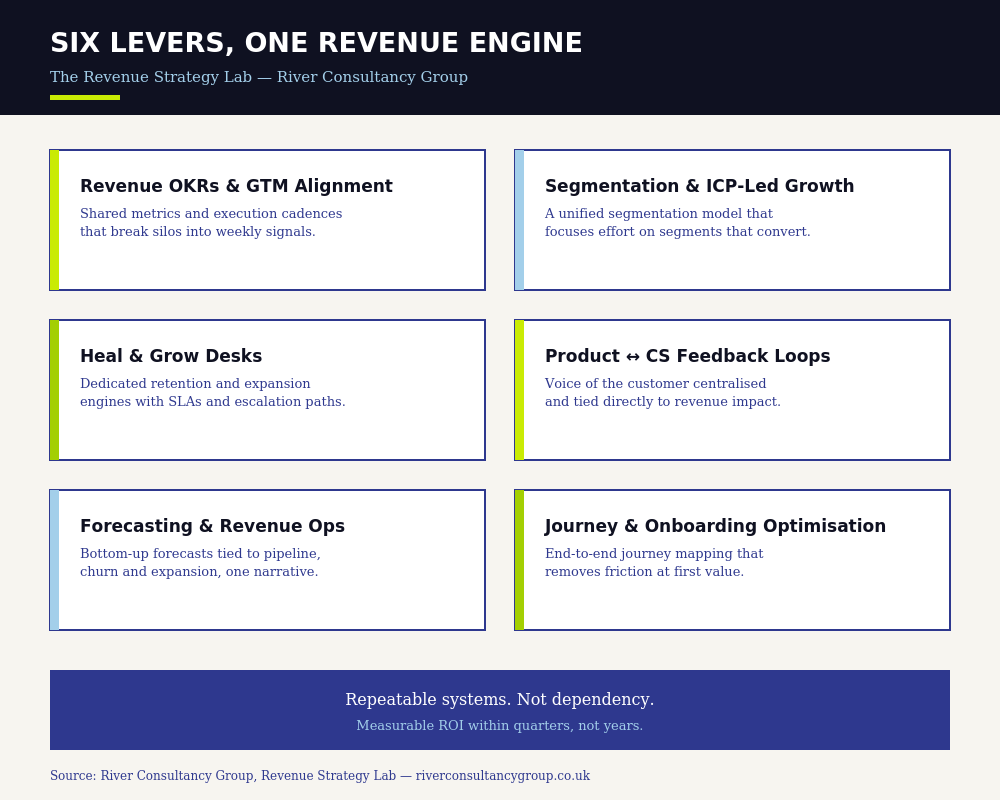
The Revenue Strategy Lab: A Framework for Revenue Operations and PE-Backed SaaS Growth Alignment
The Revenue Strategy Lab helps SaaS companies create revenue-driving OKRs, improve revenue forecasting, increase revenue efficiency, and align teams around shared business outcomes.
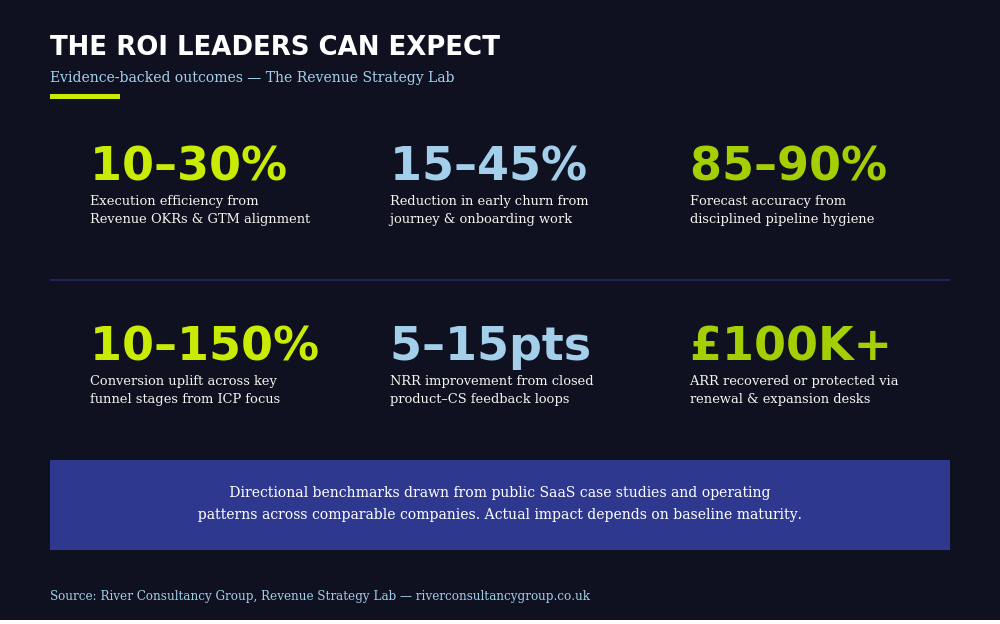
Across Revenue Strategy Lab engagements, River has observed ARR improvements exceeding 10% without corresponding increases in CAC, alongside measurable gains in retention and cross-functional alignment — the kind of portfolio company growth PE operating partners want to see repeated across every asset.
If you would like to talk more about how we can help you and your team build your revenue operations engine and Revenue Strategy Lab please reach out to myself denny.burda@riverconsultancygroup.co.uk or my partner jameslawson@riverconsultancygroup.co.uk or explore more on our website riverconsultancygroup.com
Denny Burda is CCO of River Consultancy Group and creator of the Revenue Strategy Lab. He has led revenue teams to impressive growth numbers for years and brings this same strategy to scale-up and PE-backed SaaS. To connect with Denny reach out at www.LinkedIn.com/in/dennyburda
---
Sources referenced:
- [Recurly, Churn Rate Benchmarks](https://recurly.com/research/churn-rate-benchmarks/)
- [Benchmarkit, 2025 B2B SaaS Performance Metrics Report](https://www.benchmarkit.ai/2025benchmarks)
- [David Skok, "Why Churn is Critical in SaaS," For Entrepreneurs](https://www.forentrepreneurs.com/why-churn-is-critical-in-saas/)
- [Aleph × Benchmarkit, 2026 SaaS & AI Performance Benchmarks](https://www.getaleph.com/answers/cac-payback-period-saas-2026)
- [Software Equity Group, Net Retention and Public SaaS Valuation](https://softwareequity.com/blog/net-retention-public-saas-companies/)
