
100 Days Later: The Post-Acquisition SaaS Operating Partner Playbook Winning PE Firms Are Using
What separates portfolio companies that create value fast from the ones still firefighting at month eighteen? A 100-day plan built for post acquisition SaaS.
Most post-acquisition playbooks focus on what to build. The businesses that truly fly focus first on what to stop. I've worked with over 62 different portfolio companies in the last five years. A PE firm acquires a SaaS business. The M&A team believe the investment thesis is clear and the deal is exciting, but there's a huge hidden cost somewhere in the haystack. Then, roughly by month four, the management team is exhausted. NRR likely has already dipped. A few of the best salespeople have left. The operating partner is frustrated. I can categorically tell you this is not a failure of intelligence. It is a failure of sequencing.
The real job of the first hundred days in any operating partner playbook
The businesses that perform post-acquisition are the ones where the new owners spend those hundred days building trust with the team, identifying what is driving growth, and locating the two or three constraints that are holding the business back.
"The businesses that perform post-acquisition spend the first hundred days finding out what we can determine as true. Not installing what they planned to be true."
Building trust before you touch anything else
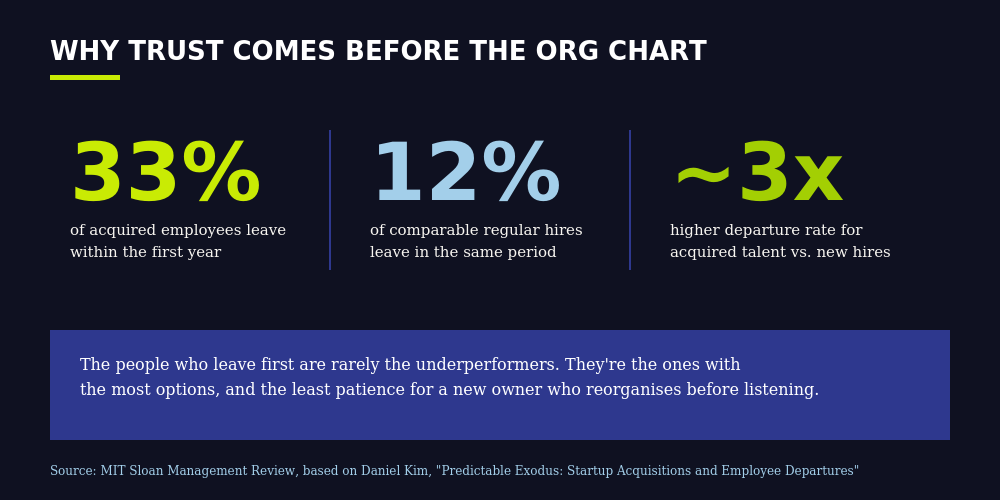
Trust is the precondition for the rest of the plan working. MIT Sloan's research on acquired workforces found that 33% of acquired employees leave within the first year, roughly three times the departure rate of comparable hires. Source Having scaled a CS function from 6 to 63 people myself, the people who leave first are rarely the underperformers, they're the ones with the most options and the least patience for a new owner who reorganises before listening. The first two weeks should be direct conversations with the team that built the business, not a town hall deck.
Finding what's actually driving growth, not just where the spend is going
Every acquired SaaS business has a story about what's driving its growth. Half the time that story is wrong, built on whichever metric was easiest to report pre-deal. Bain's private equity practice, which has worked on more than half of all $500 million-plus buyouts globally since 2000, describes the first 100 days as the period to bring genuine analytical rigor to the deal hypothesis. Source In practice, that means pulling new logo growth apart from expansion and testing whether the "strong pipeline" narrative survives contact with actual conversion data.
What I have seen inside SaaS businesses in the first hundred days
Net revenue retention is being reported incorrectly. The customer success function is operating as a support desk, not a commercial motion. The sales team's pipeline is full but conversion is low, because ICP has drifted. Onboarding takes longer than it should.
Locating what's actually stalling the business
Each of those four symptoms traces back to a different kind of constraint, and mixing them up wastes the first hundred days on the wrong fix. Goldratt's Theory of Constraints, identifying the single limiting factor before intervening anywhere else, applies well here: a system can only have one real constraint at a time. Source In the businesses I've worked with, it's almost always one of four types: People (a commercial skill gap, usually CS or RevOps), Process (reporting infrastructure that misreports NRR for months), GTM (ICP drift, so pipeline volume looks healthy while quality erodes), or Market (a shift in buyer behaviour no internal fix will solve). Diagnosing which one you're looking at, before prescribing, is the job.
The sequencing that really works in a post-acquisition SaaS 100-day plan
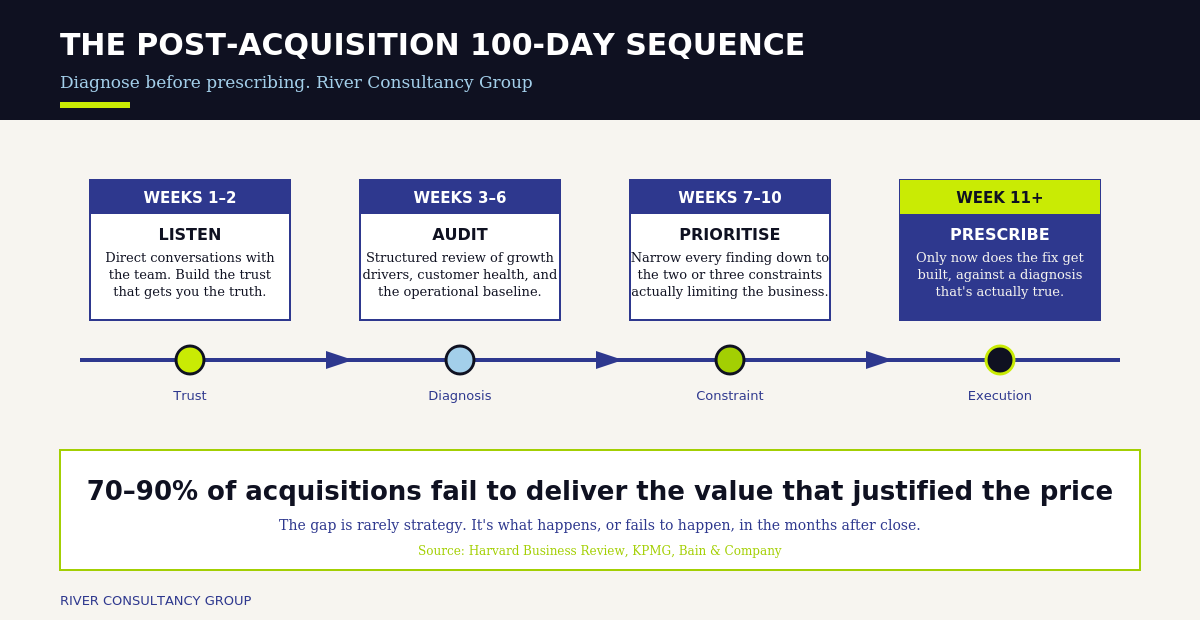
Diagnose before prescribing. Hold off on new initiatives for the first six weeks and run a structured audit of the commercial engine, customer health, and operational baseline.
In practice, I break this into three phases: weeks one and two for listening, direct conversations that build the trust needed for people to tell you the truth later; weeks three through six for the structured audit, pulling apart growth drivers and mapping the operational baseline; weeks seven through ten for constraint prioritisation, narrowing what the audit surfaced down to the two or three issues actually limiting the business. Only after that does prescription start.
This sequencing matters more than it sounds. Research compiled from Harvard Business Review, KPMG, and Bain & Company consistently finds that 70 to 90% of acquisitions fail to deliver the value that justified the purchase price. That gap is rarely a strategy problem. It's what happens, or fails to happen, in the months right after close. Source
Why this matters more in SaaS than in other sectors
SaaS businesses are operationally fragile in a specific way. Their revenue looks stable (ARR) but the underlying health can deteriorate quietly for six to twelve months before it shows up in the numbers.
This is why the 100-day plan matters as the foundation of any post-acquisition SaaS operating partner playbook.
If you would like to talk more about how we can help you build a post-acquisition SaaS 100 day plan please reach out to myself jameslawson@riverconsultancygroup.co.uk or my partner denny.burda@riverconsultancygroup.co.uk or explore more on our website riverconsultancygroup.com
James Lawson is founder of River Consultancy Group, a specialist advisory practice helping PE-backed SaaS businesses identify and unlock growth. He has scaled post-acquisition CS functions from 6 to 63 people and managed a $140M ARR portfolio across global law firms. Connect: linkedin.com/in/jlaw-maketheboatgofaster
---
Sources referenced:
- [MIT Sloan, "Your acquired hires are leaving. Here's why."](https://mitsloan.mit.edu/ideas-made-to-matter/your-acquired-hires-are-leaving-heres-why)
- [Bain & Company, Private Equity Value Creation research](https://www.bain.com/insights/pricing-global-private-equity-report-2020/)
- [Theory of Constraints Institute, Eliyahu M. Goldratt](https://www.tocinstitute.org/theory-of-constraints.html)
- [Post-Acquisition Integration Plan research summary, citing HBR, KPMG, and Bain & Company](https://www.ferdinandpartners.com/article/post-acquisition-integration-plan-how-to-avoid-value-destruction-in-the-first-100-days)
