
Due Diligence &
Strategic Audits
Growth alone does not guarantee structural readiness.
Growth alone does not guarantee structural readiness. Before capital is deployed or scale is accelerated, it is critical to understand whether the organisation’s operating systems can support the next stage of growth.
Our due diligence and strategic audits provide an independent, institutional-grade assessment of the commercial, technological, and operational foundations of the business, identifying where risk is concentrated, where growth is constrained, and where measurable ARR opportunity exists.


SaaS Growth Audit
Independent Scalability & Enterprise Readiness Assessment
Is the business structurally built to scale, or is growth masking systemic risk?
The SaaS Growth Audit provides a board-level evaluation of the company’s operating system, commercial execution, leadership capacity, operational discipline, technology foundations, and governance maturity. Designed for investors, boards, and leadership teams preparing for accelerated growth or capital events, the audit identifies where structural constraints may limit scalable ARR growth.
This is a structured assessment of the organisation’s ability to support sustained growth and enterprise-level execution.
What We Assess
Leadership and organisational maturity required to sustain scale.
Commercial execution and revenue operating discipline.
Operational processes supporting predictable growth.
Technology and infrastructure readiness for expansion.
Governance, decision-making frameworks, and innovation capacity.
Outcome
Independent, evidence-based view of scalability constraints and risks
Visibility into revenue durability, operational fragility, and leadership gaps
Clear 90–180 day blueprint for improving growth readiness
Defined actions to unlock measurable ARR opportunity
IT Architecture Due Diligence
Platform Scalability & Engineering Maturity Assessment
Is the technology platform capable of supporting the company’s growth ambitions?
The IT Architecture Due Diligence provides a structural evaluation of the platform’s architecture, infrastructure, and engineering execution maturity. Designed for investors and leadership teams preparing for accelerated scale or transaction, the audit reveals whether the technology foundation can support enterprise-level reliability and growth.
This is a systemic evaluation of the technical architecture supporting enterprise value.
What We Assess
Architecture scalability, system design, and performance limits
Infrastructure resilience, cloud governance, monitoring, and disaster recovery
Engineering execution, deployment reliability, and workflow discipline
Security posture, compliance exposure, and vulnerability management
Technical debt, platform dependencies, and long-term maintainability
Engineering team structure, ownership clarity, and delivery capacity
Technology roadmap credibility and alignment with growth strategy
IT governance, build vs buy decisions, and cost visibility
Outcome
Clear view of whether the platform can support the next
stage of growth
Identification of scalability ceilings and infrastructure
fragility
Visibility into security exposure and technical debt risk
Defined actions to strengthen long-term platform resilience

CRM Integrity
Revenue systems are often treated as reporting tools.
In reality, they are the operating backbone of the revenue organisation.
The CRM Due Diligence provides an independent evaluation of whether the company’s CRM reinforces disciplined execution or introduces distortion across forecasting, pipeline governance, and reporting. The assessment determines whether the system can support predictable growth and withstand investor scrutiny.
A CRM should do more than store pipeline data. It should reinforce disciplined execution across the revenue organisation.
What We Assess
Pipeline architecture, stage governance, and qualification discipline.
Forecast methodology integrity and predictive reliability.
Data hygiene, duplication risk, and structural reporting accuracy.
Revenue workflow design across lead-to-close, renewal, and expansion processes.
System integration maturity across marketing automation, customer success, and billing platforms.
Reporting architecture, KPI standardisation, and board-level reporting reliability.
User adoption discipline, behavioural compliance, and operational process integrity.

Outcome
Clear view of forecast reliability, pipeline integrity, and reporting
confidence
Visibility into revenue leakage across the customer lifecycle
Identification of weaknesses in system design, data governance, and discipline
CRM reliability score and prioritised remediation roadmap
Actions to improve forecasting accuracy and board-level reporting confidence

AI Risk, Profitability & Efficiency Assessment
AI adoption is accelerating across modern organisations. The challenge is determining whether the systems supporting it are governed, scalable, and operationally sound.
The AI Due Diligence provides an independent assessment of the organisation’s AI governance, deployment maturity, operational controls, and strategic readiness. Designed for investors and leadership teams preparing for scale, the audit identifies where AI strengthens business performance and where unmanaged risk may compromise growth, compliance, or operational resilience.
AI should function as a strategic capability, not an uncontrolled operational dependency.
What We Assess
AI governance, accountability, and policy maturity
Regulatory exposure and compliance readiness
Data governance, lineage, and legal rights controls
Model performance, risk management, and evaluation standards
Security, privacy, and incident response readiness
Transparency, explainability, and human oversight
Deployment controls, monitoring, and operational discipline
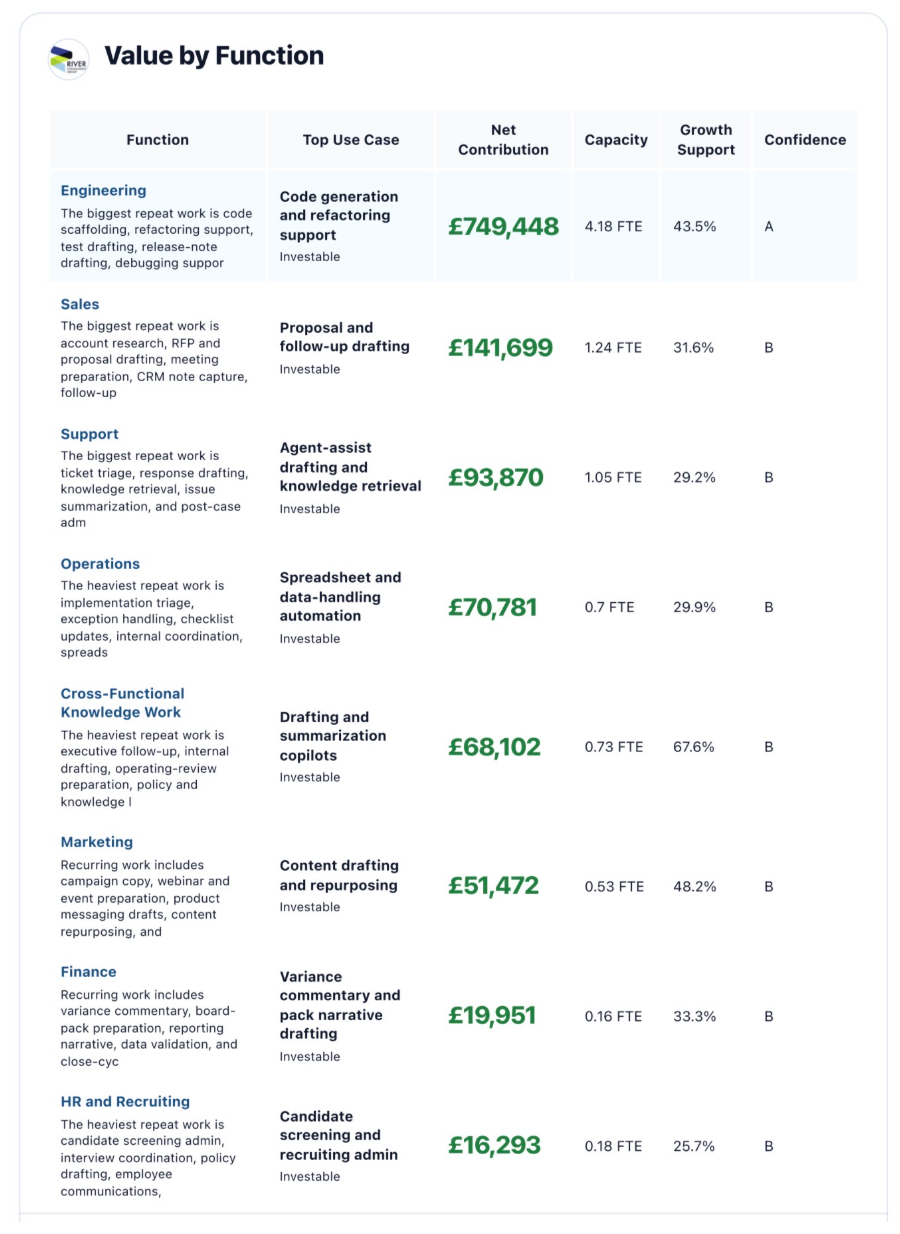
AI adoption across Sales, Marketing, Finance, HR, and Operations
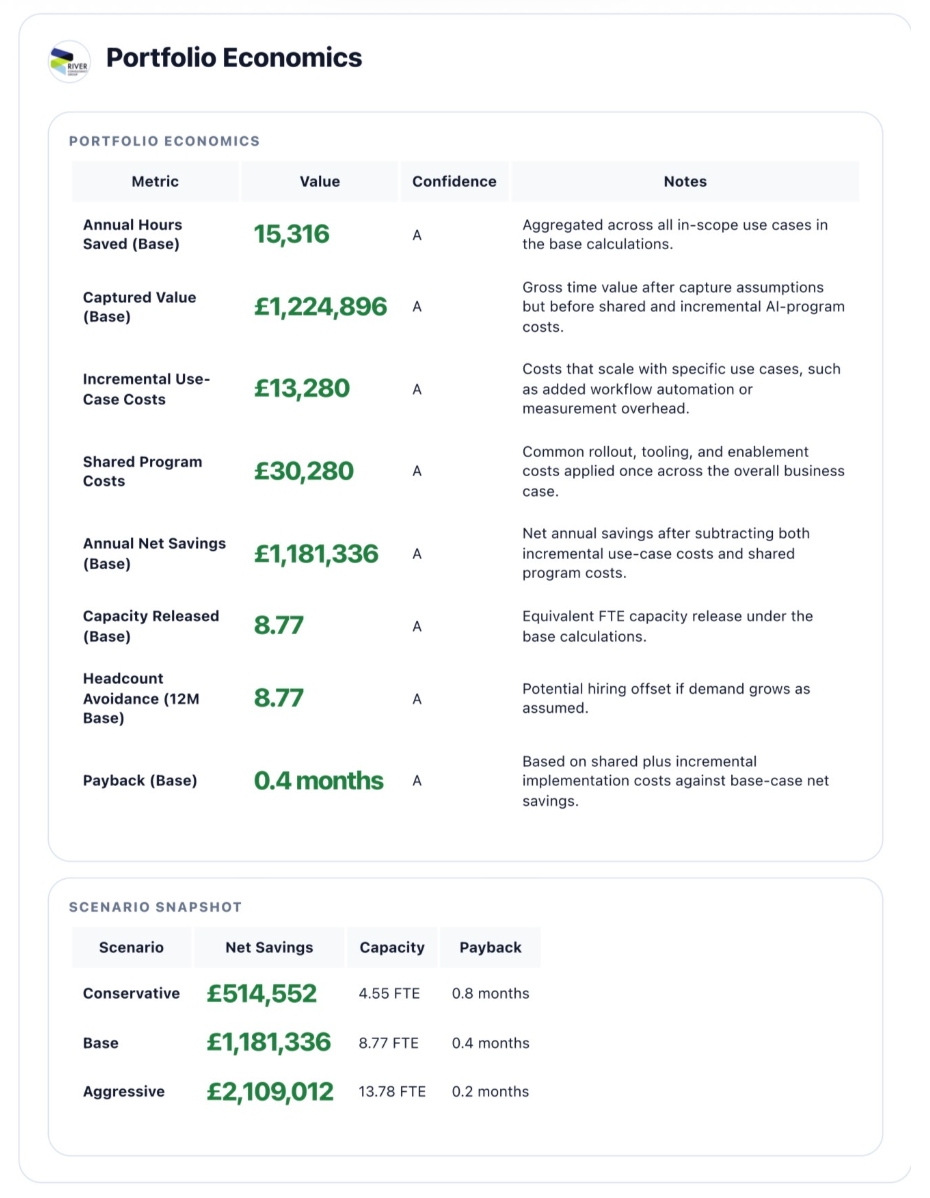
Efficiency, productivity, and profitability impact
Strategic alignment between AI initiatives and business growth
Outcome
Clear visibility into AI governance maturity and operational readiness
Identification of compliance exposure, security risk, and accountability gaps
Stronger confidence in AI deployment, monitoring, and oversight controls
Reduced operational and reputational risk tied to AI adoption
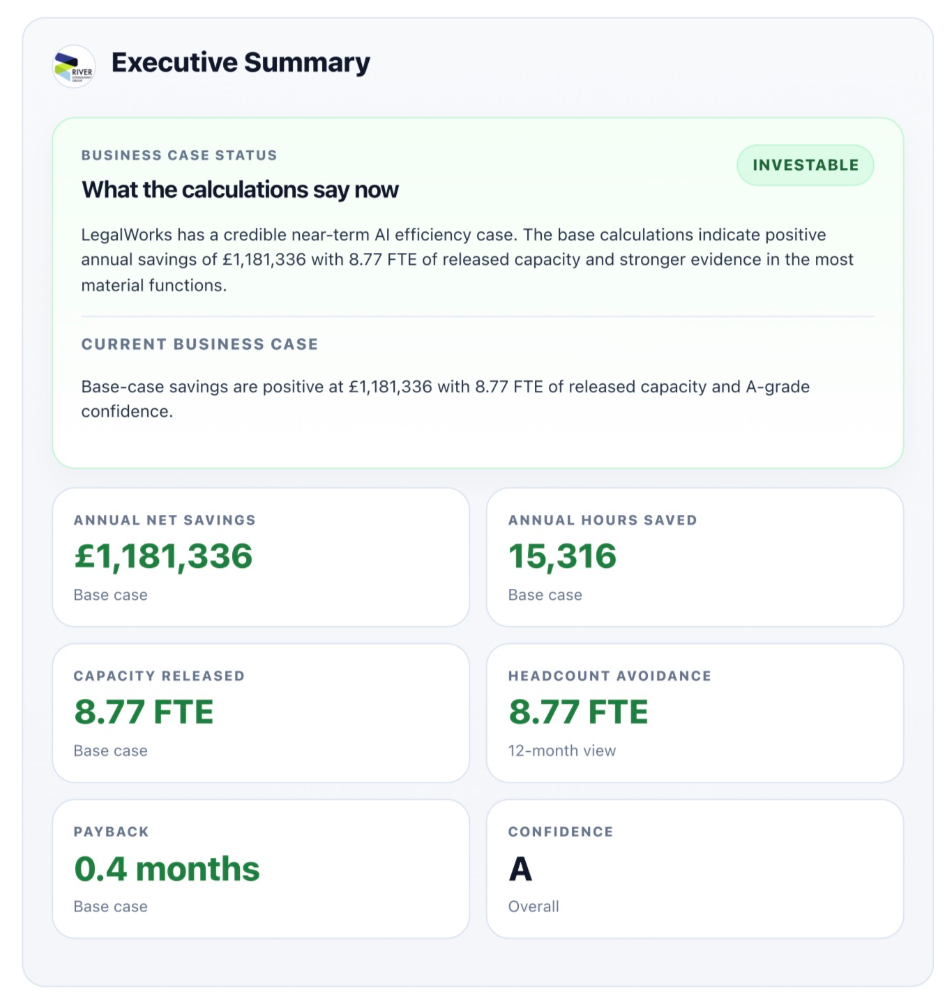
Defined opportunities to improve efficiency, productivity, and profitability
Clear roadmap for responsible, scalable AI implementation

Portfolio Intelligence Audit
Standardised Portfolio Intelligence for Private Equity and Investment Groups
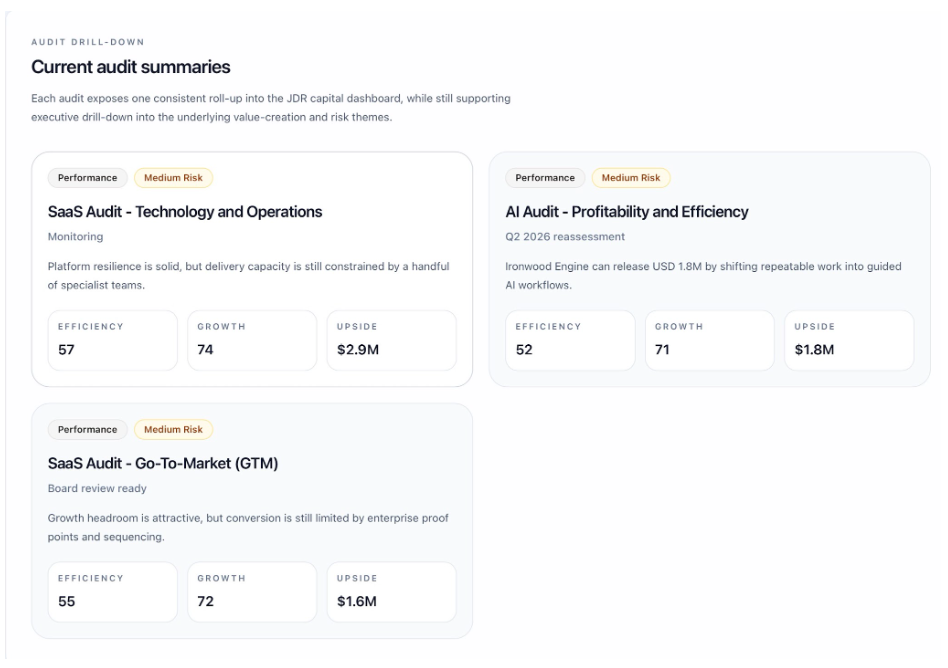
Scaling a portfolio requires more than financial reporting. Investors need visibility into the operational systems driving growth.
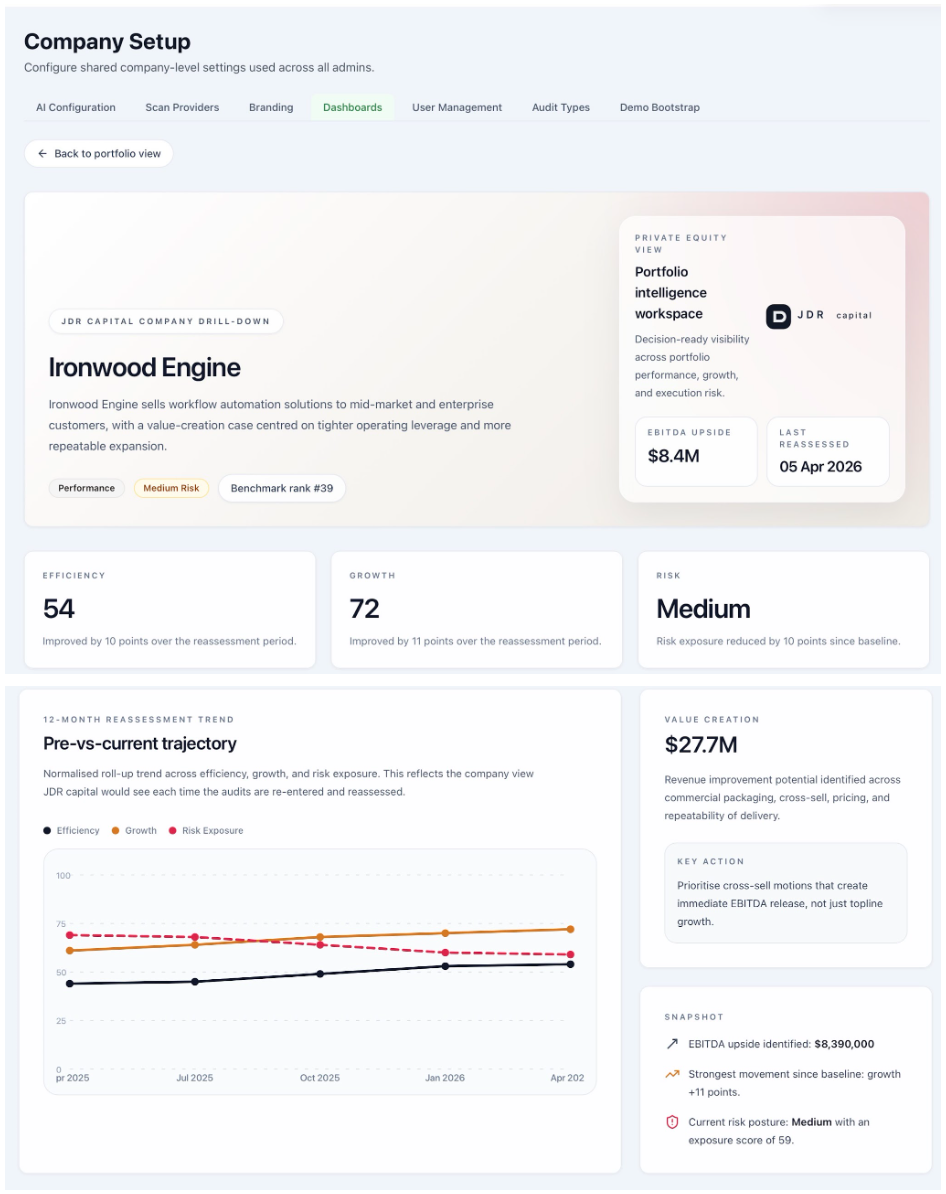
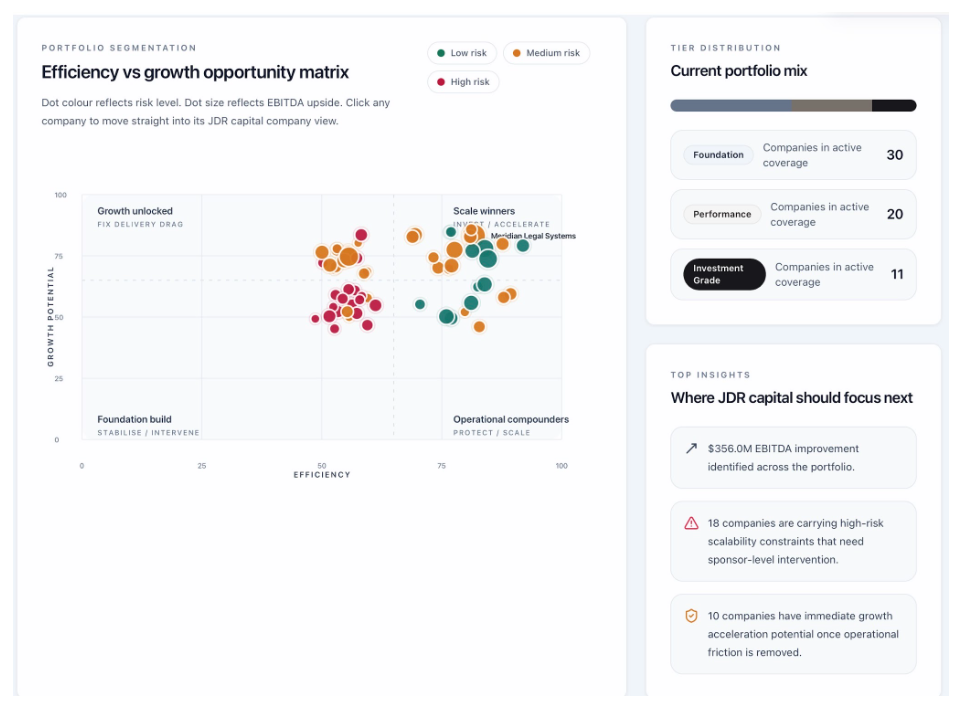
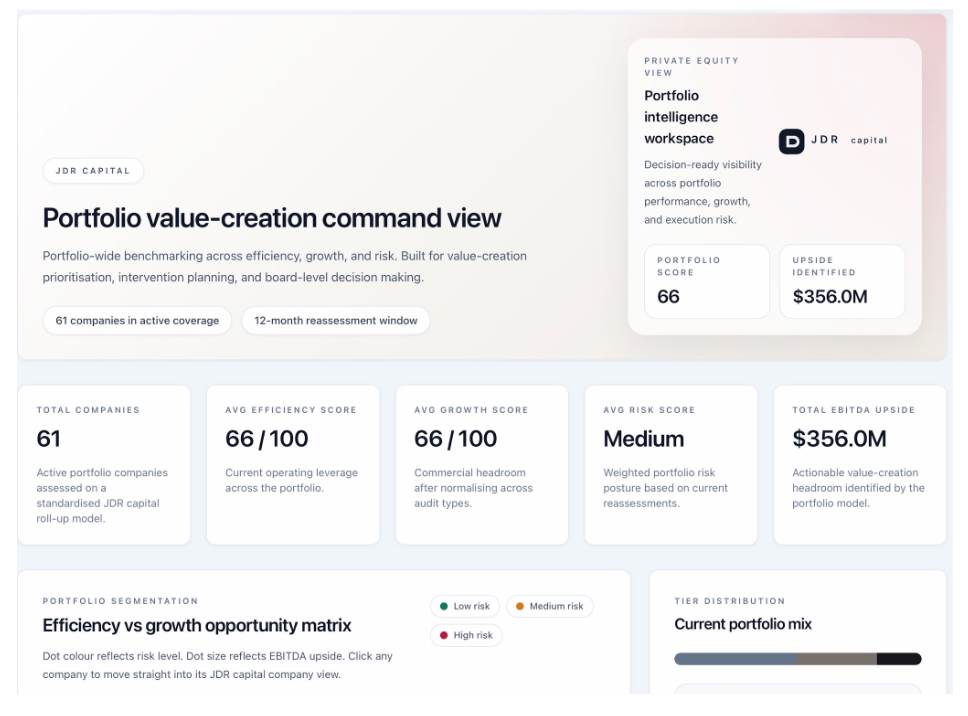
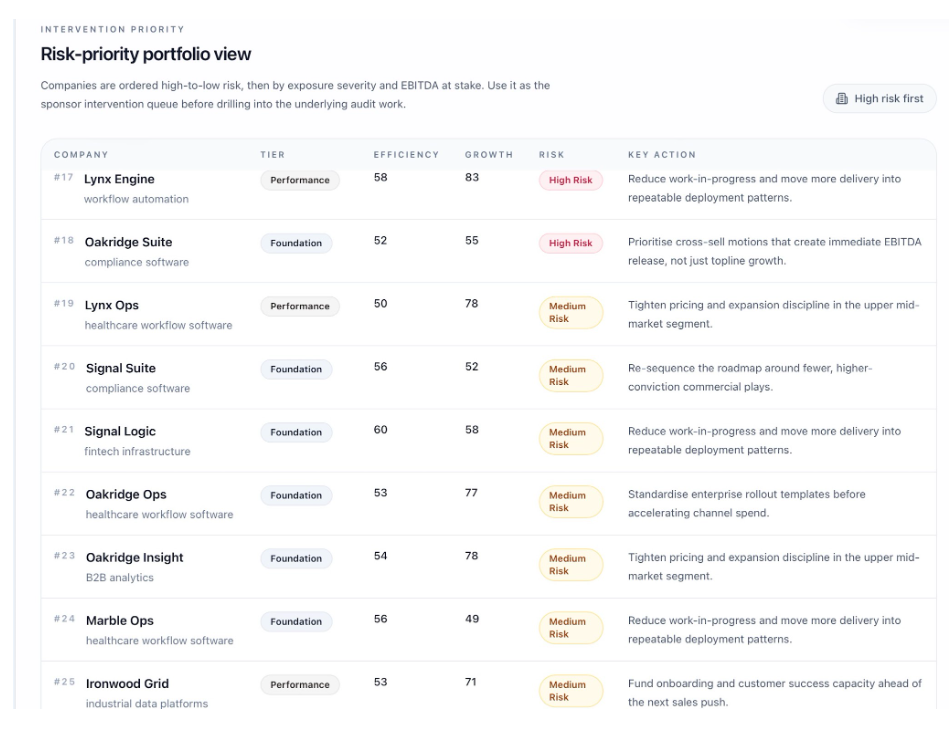
The Portfolio Audit Package provides private equity firms and investors with a consistent, cross-portfolio assessment framework combining AI governance, commercial growth readiness, and core technology infrastructure evaluation. Designed to run across multiple portfolio companies, the audit delivers comparable insights into scalability, operational maturity, security posture, and revenue growth capability.
This is not a collection of disconnected assessments. It is a standardised investment intelligence framework designed to benchmark portfolio performance, surface operational risk, and identify measurable growth opportunities across the portfolio.
What We Assess
Commercial growth readiness and go-to-market execution maturity
AI governance, deployment readiness, and operational controls
Core technology infrastructure, scalability, and security posture
Revenue operating discipline and growth efficiency indicators
Cross-functional operational maturity and execution capability
Benchmark positioning across portfolio companies and industry peers
Scalability constraints, operational risk, and value creation opportunities
Outcome
Standardised visibility across portfolio company performance and readiness
Clear benchmarking against peer companies and audit datasets
Identification of operational, commercial, and AI-related risk exposure
Improved portfolio-wide visibility into scalability and investment readiness
Clear prioritisation of value creation and operational improvement opportunities
Portfolio-level reporting designed to support investment and growth decisions
Portfolio Dashboard