
The Pace Band Problem: What 10 to 25% ARR Growth Actually Takes
Published on 12 August 2026 • Written by Denny Burda
A revenue operations framework for founder-led and PE-backed SaaS teams who are chasing a growth number without a plan for how to hold the pace.
Dont ever ask me to run. It isnt pretty. So my knowledge on this comes second hand from some friends who are very into it, but I think the analogy is sound. Every marathon runner who's serious about a time goal carries a pace band. It's a simple strip of paper wrapped around the wrist with a split time written next to every mile marker: 8:02 at mile one, 16:11 at mile two, and so on. The band exists because almost every failed marathon starts the same way. The runner feels great in the first 10K, runs it faster than planned, and pays for it in mile 20 when the legs give out and the pace collapses.
Growth targets work the same way. A board sets a target of 15% ARR growth for the year, and the instinct across the business is to push harder everywhere at once: more pipeline, more reps, more spend. That's the equivalent of running the first 10K too fast. It feels like progress, and it quietly guarantees a collapse later, usually in the form of rising CAC, softening retention, or a sales team burning through territory that was never going to convert.
Growth targets don't fail from lack of effort. They fail from lack of pacing.
Why Plans Outrun the Pace
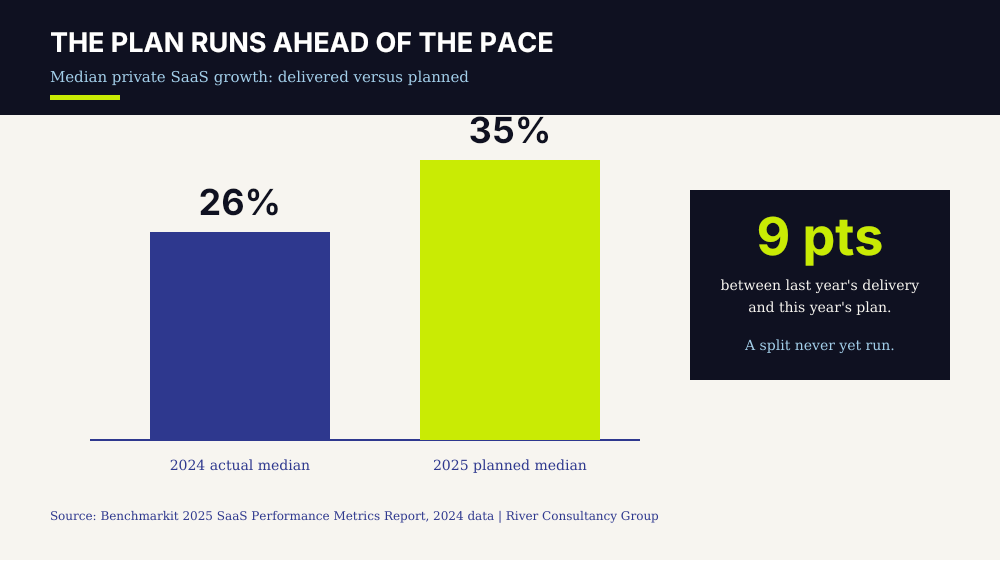
The gap between the plan and the pace is visible in the data. Benchmarkit's 2025 SaaS Performance Metrics report found that private SaaS companies grew at a median 26% in 2024, yet planned a median 35% for 2025, and companies of every size planned higher growth than they had just delivered. A nine point gap between plan and last year's actual is a runner who has written a faster split than they have ever run.
The same instinct to sprint early has a long record in the startup literature. The Startup Genome Project's analysis of more than 3,200 high-growth tech startups found that about 70% showed premature scaling, meaning some part of the business, such as team or spend, was operating at a later stage than the customer evidence supported, and that startups scaling in step with their evidence grew far faster. That dataset is from 2011 and covers early-stage tech rather than scale-up SaaS, so treat it as directional. The principle is the one we see in PE-backed businesses today: scaling spend ahead of proof is how a good first 10K becomes a bad mile 20.
Where Sustainable ARR Growth Actually Comes From
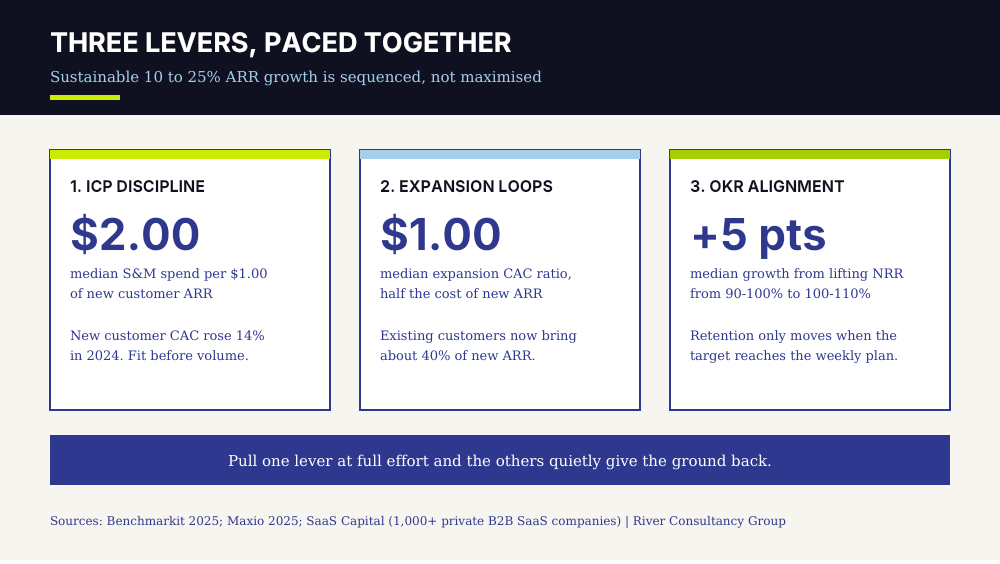
At River, the Revenue Strategy Lab exists because "grow faster" is not a plan, it's a direction. The companies that hit 10 to 25% ARR growth without breaking something else in the process are pulling three specific levers, deliberately paced against each other, not pushing on all of them at maximum effort simultaneously.
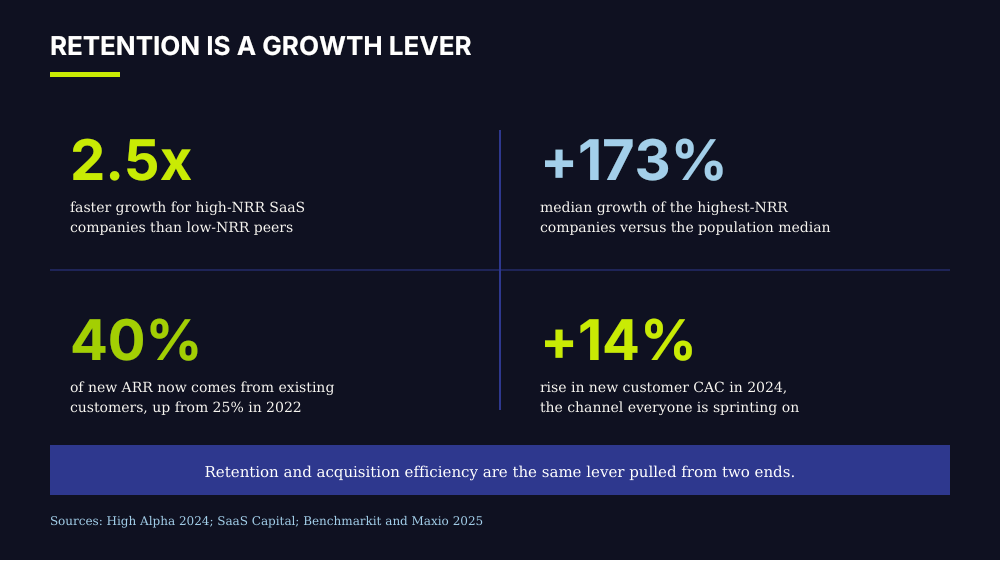
ICP discipline. Tightening who you sell to before you try to sell to more people. A pipeline full of poor-fit accounts doesn't just lower win rates, it consumes the same rep capacity and CS bandwidth as a well-fit account while returning a fraction of the lifetime value. Fixing the top of the funnel is almost always cheaper than fixing the bottom. The cost of ignoring it is already showing: Benchmarkit found new customer CAC rose 14% in 2024, and the median company now spends about $2.00 of sales and marketing to win each $1.00 of new customer ARR.
Expansion loops. Benchmarkit's 2025 data, published with Maxio, found that existing customers now generate roughly 40% of new ARR, up from a 25% median in 2022. The efficiency gap explains why. The same Benchmarkit report puts the median expansion CAC ratio at $1.00, half the cost of new customer ARR. Growth that relies solely on new-logo acquisition is competing in an increasingly expensive channel while ignoring the one that's already paid its CAC.
OKR alignment. Growth targets set at the top only translate into results if they cascade into what individual teams actually prioritize week to week. A target that lives on a board slide and nowhere else in the operating rhythm isn't a growth plan, it's a hope.
Most companies don't miss their growth number because the target was wrong. They miss it because they tried to hit it by running every mile at the same pace.
What the Data Says About the Cost of Ignoring the Pace Band
This isn't just an operating philosophy, it shows up directly in the benchmark data.
Benchmarkit's report found median private SaaS growth settling at 26%, with top-quartile growth cooling from 60% in 2023 to 50% in 2024. SaaS Capital's survey of more than 1,000 private B2B SaaS companies put median growth at 22%, down from 25% the prior year. Growth is getting harder to buy purely through acquisition spend, which is exactly why the companies still compounding are pulling more than one lever.
Retention is the clearest evidence that the levers are connected. SaaS Capital found growth is positively and exponentially correlated with net revenue retention: moving from the 90 to 100% NRR band to the 100 to 110% band lifts median growth by about 5 percentage points, and the companies with the highest NRR grow a median 173% faster than the population median. It describes upsell and cross-sell as "a rare example of increasing returns" from investment. High Alpha's 2024 SaaS Benchmarks Report, cited in its own NRR analysis, reaches a similar conclusion: high-NRR SaaS companies grow 2.5 times faster than low-NRR peers. Retention and acquisition efficiency aren't separate initiatives competing for attention. They're the same lever pulled from two ends.
A company running one lever at full effort and ignoring the others isn't running faster. It's running unevenly, and unevenly is how growth breaks down before the finish line.
What a Pace Band Looks Like in a SaaS Business
A pace band is not a lower target. It is a target with splits. In practice that means three things:
Sequence the levers. Fix ICP fit and onboarding before adding pipeline volume, so new customers land into a base that retains.
Set splits, not just a finish time. Quarterly checkpoints on new CAC ratio, expansion share of new ARR and NRR, so a drift shows up at mile 8, not mile 20.
Hold back the surge. When a quarter runs ahead, the discipline is to bank the retention gain rather than spend it all on more acquisition.
Hitting the Number Means Holding the Pace, Not Just Pushing Harder
Sustainable ARR growth isn't a function of maximum effort applied everywhere. It's a function of pacing the levers that actually compound, ICP discipline, expansion, and OKR alignment, so that growth in one area doesn't quietly cost you ground in another.
The Revenue Strategy Lab: Setting the Pace for Sustainable Growth
The Revenue Strategy Lab, our flagship methodology, is what we apply as embedded Fractional Growth Partners to build exactly this kind of paced growth plan: ICP scoring that keeps pipeline capacity pointed at the accounts worth the effort, expansion programs that treat the existing base as a growth channel rather than an afterthought, and OKRs that cascade into what teams actually do each week.
Across Revenue Strategy Lab engagements, companies have achieved 10 to 25% ARR growth without the acquisition cost spikes or retention softening that tend to follow an all-effort, no-pacing push. Set against a market median growth rate of roughly 22 to 26%, that range isn't a stretch target, it's proof the growth can be held rather than just reached for a single quarter.
If you'd like to talk about where your growth plan needs a pace band rather than more effort, reach out to me at denny.burda@riverconsultancygroup.co.uk or my partner James at jameslawson@riverconsultancygroup.co.uk, or explore more at riverconsultancygroup.co.uk.
Denny Burda is CCO of River Consultancy Group and creator of the Revenue Strategy Lab. He has led revenue teams to sustained growth across founder-led and PE-backed SaaS businesses. Connect with Denny at linkedin.com/in/dennyburda.
Sources referenced:
