
The Buy-and-Build SaaS Saga: The PE Software M&A Mistake That Costs You the Multiple
Published on 19 August 2026 • Written by James Lawson
Post-merger integration SaaS lessons from the front line: the single mistake that quietly destroys value in portfolio company integration.
Buy-and-build is the defining PE software M&A playbook for European software. It works super well when the integration model is right. But there is one mistake that destroys more value in bolt-on acquisitions than any other, and it almost never appears in the post-deal review.
The buy-and-build thesis is very compelling, and for good reason. Take a fragmented European software market, acquire a platform, bolt on complementary assets, standardise ops, and sell a larger, more profitable business at a higher multiple than you could have built organically. The logic is sound, but it's the execution, the post-merger integration SaaS businesses actually have to live through, where it gets complicated.
Bain's Global Private Equity Report on buy-and-build captures the tension well. It found that platforms making at least four sequential add-ons now account for roughly 30% of add-on deals, and that the strategy has produced some excellent outcomes. It also warned that buy-and-build has at times "badly underperformed" other strategies, and that integration capacity and systems bottlenecks have to be addressed early. The same report credits multiple arbitrage as a core value path, because smaller add-ons trade at lower multiples than the platform. That arbitrage only pays if the customers you bought are still there when you sell.
I have been involved in both sides of the integration challenge, building out a post-acquisition CS function from scratch following a major acquisition at Litera, and also as an advisor to PE-backed businesses through the commercial turbulence that follows when a bolt-on does not integrate as planned.
The mistake that destroys multiples in portfolio company integration
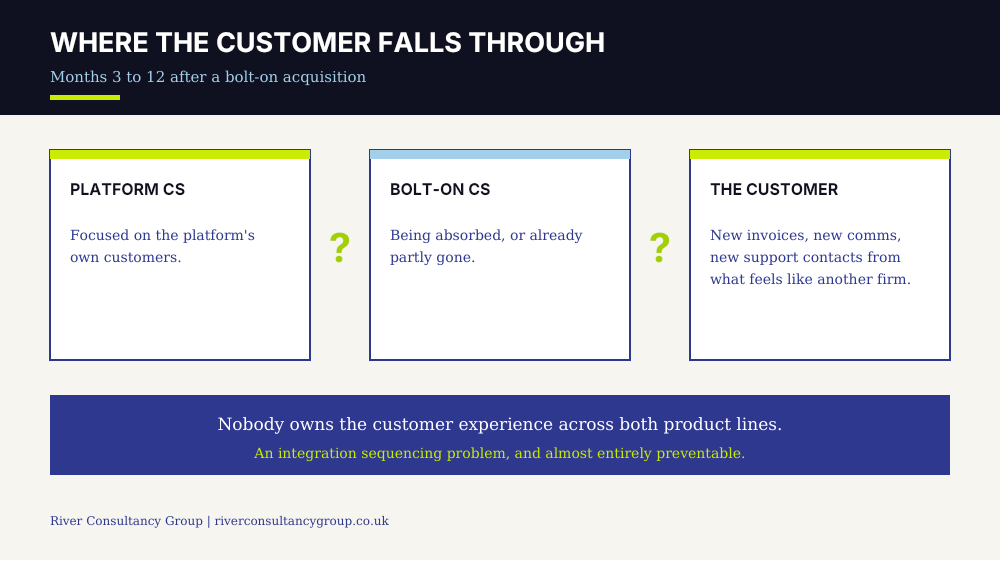
It is not the technology integration and it is not the go-to-market alignment. The value destruction in most buy-and-build SaaS integrations comes from customer confusion, specifically the period of three to twelve months post-acquisition during which nobody is clearly responsible for the customer experience across both product lines.
The platform company's CS team is focused on the platform's customers. The bolt-on's CS team (if it had one) is either being absorbed or has already partially left. And the customer, who signed a contract with one business, is now receiving communications, invoices, and support from what feels like a different one.
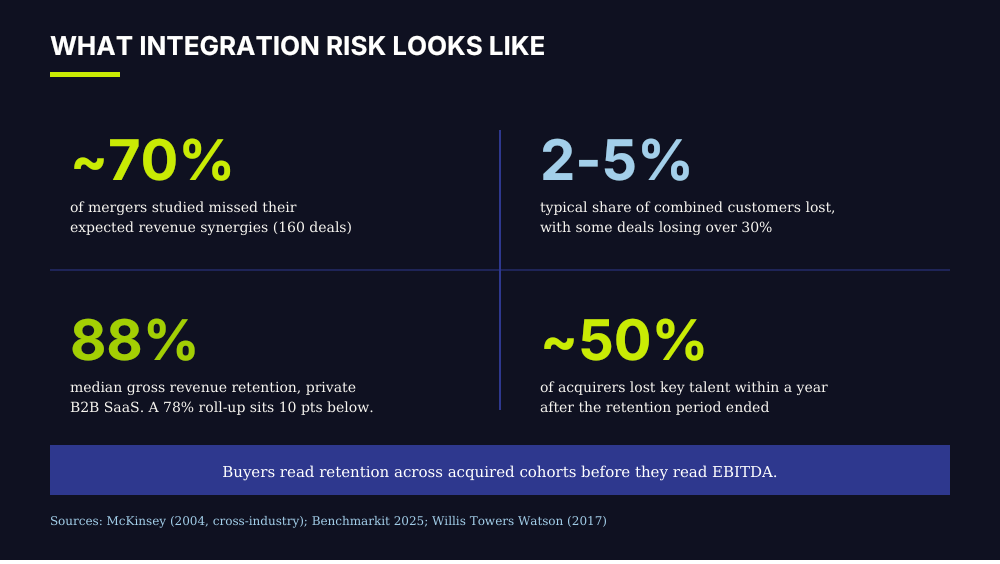
The older merger research says this is a blind spot in the deal model, not a rare accident. McKinsey's analysis of 160 mergers, Where Mergers Go Wrong, found that almost 70% failed to achieve the revenue synergies expected, and that acquirers often ignore revenue dis-synergies such as customer losses from disrupted operations. In the 124 mergers with customer data, the typical company lost 2 to 5% of its combined customers (the interquartile range), and some lost more than 30%. That study dates from 2004 and spans all industries, so it is not a SaaS benchmark. But subscription software makes the exposure sharper, because every one of those customers can leave at their next renewal.
"Customer churn in the 12 months post-acquisition is not a business development problem. It is an integration sequencing problem. And it is almost entirely preventable."
What's the solution for post-merger integration SaaS teams
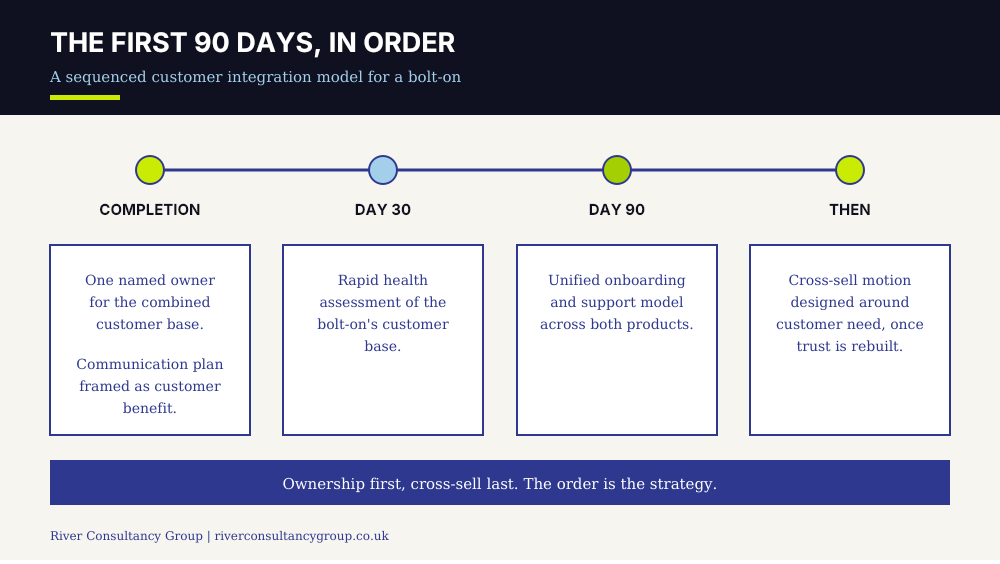
A single named owner for the combined customer base from completion. A customer communication plan that explains the acquisition in terms of customer benefit. A rapid health assessment of the bolt-on's customer base within the first thirty days. A unified onboarding and support model within ninety days. A cross-sell motion designed around customer need.
The order matters as much as the list. Ownership and communication come first, because they stop the silence. The health assessment comes next, because it tells you which accounts need a senior conversation this month rather than a survey next quarter. Unified onboarding and support follow, once you know what you are unifying. Cross-sell comes last, because a customer who does not yet trust the combined business will not buy a second product from it.
The number that matters at exit in PE software M&A
Gross revenue retention across the combined entity is one of the first metrics a sophisticated buyer will examine in a buy-and-build exit. A business that has made three bolt-on acquisitions but has 78% gross retention is telling a story of an integration struggle, regardless of what the EBITDA shows.
For context, Benchmarkit's 2025 SaaS Performance Metrics report puts median gross revenue retention for private B2B SaaS at 88%, so 78% sits ten points below the median. Retention then feeds straight into valuation. In Software Equity Group's analysis of public SaaS companies, firms with net retention above 120% traded at a 63% premium to the index median while those below 100% traded at a 46% discount (2Q24 data; SEG's 2Q26 report puts the index median multiple at 3.2x, so absolute multiples have compressed while the ordering holds). A buyer who sees weak retention across acquired cohorts will price the integration risk into the multiple.
The talent dimension of portfolio company integration
The greatest people at the bolt-on business, the ones who knew the customers personally, are the most likely to leave in the first six months if the integration is handled badly. Their institutional knowledge is worth significantly more than their salary.
Willis Towers Watson's M&A retention survey of 244 organisations across 24 countries, reported by Consultancy.uk, found that people leave after acquisitions mainly because of culture clashes (44%), poaching by competitors (36%) and disliking their new role (25%). It also found that retention efforts skew toward senior leaders and their direct reports, that 77 to 80% of companies use cash bonuses as the main retention tool, and that around half of companies lost key talent within a year after the retention period ended. That last finding is the one I see most often in practice: the retention bonus pays out, and the person who held the customer relationship leaves a few months later.
Buy-and-build really is a brilliant PE software M&A strategy. But the multiple you achieve at exit is determined as much by how well you protect and grow the customers you acquired as by how many acquisitions you made.
If you would like to talk more about how we have helped others mitigate the risks that cost them multiples in buy-and-build and post-merger integration please reach out to myself jameslawson@riverconsultancygroup.co.uk or my partner denny.burda@riverconsultancygroup.co.uk or explore more on our website riverconsultancygroup.co.uk
James Lawson is founder of River Consultancy Group. He scaled Litera's post-acquisition CS function from 6 to 63 people, managing a $140M ARR legal technology portfolio across global law firms through a period of active M&A growth. Connect: linkedin.com/in/jlaw-maketheboatgofaster
Sources referenced:
