
Two Leaders, One Boat: Solving the CCO and CRO Tension That Sinks SaaS Revenue
Published on 2 September 2026 • Written by James Lawson
Why revenue leadership alignment between the CCO and CRO is the highest-leverage go-to-market strategy fix in PE-backed SaaS growth.
In most B2B SaaS businesses, the relationship between the Chief Customer Officer and the Chief Revenue Officer is the single most commercially consequential dynamic in the senior team. If you've hired well, they will be two big characters who feel like family when they work together. However, much like family, when it doesn't work it can be extremely expensive and often quietly uncomfortable. When it does work, it's one of the most powerful duos any revenue leadership team could wish for.
You may be very familiar with this if you are in a PE-backed SaaS business at a senior level.
The CRO is commonly measured on new ARR. Their team is incentivised to close deals, the best and good fit ICP deals ideally, but deals. In short if your CRO is only driving the funnel and not the loop they are really just a VP of Sales with a bigger title and bigger salary.
The CCO is commonly measured on retention and NRR. Their team is responsible for making sure the customers those deals brought in have a great onboarding experience, stay, grow, and succeed. However, the cold hard reality is they are frequently in tension and that tension bleeds commercial value in ways that are rarely captured in a board report.
How the go-to-market tension manifests
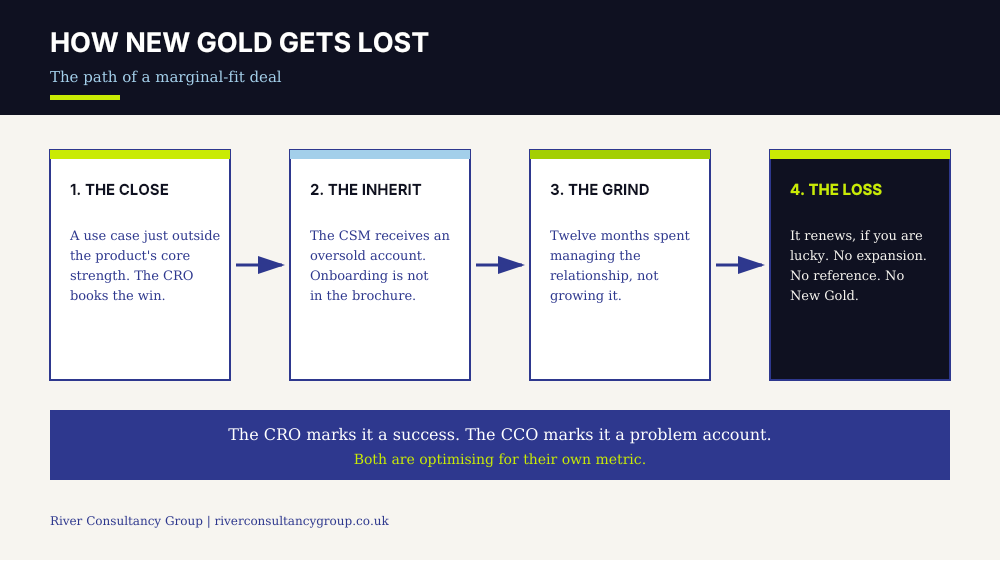
The most common failure tends to start when Sales closes a customer whose use case is marginally outside the product's core strength. The CSM inherits an account that was oversold or misaligned with what is possible. Onboarding then proves to be a journey that isn't in the brochure.
Then the CSM spends twelve months managing the relationship rather than growing it. The account renews if you are lucky and the CRO marks it as a successful deal while the CCO marks it as a problem account. Neither the CCO nor the CRO is wrong in their endeavours. Both are optimising for their own metric.
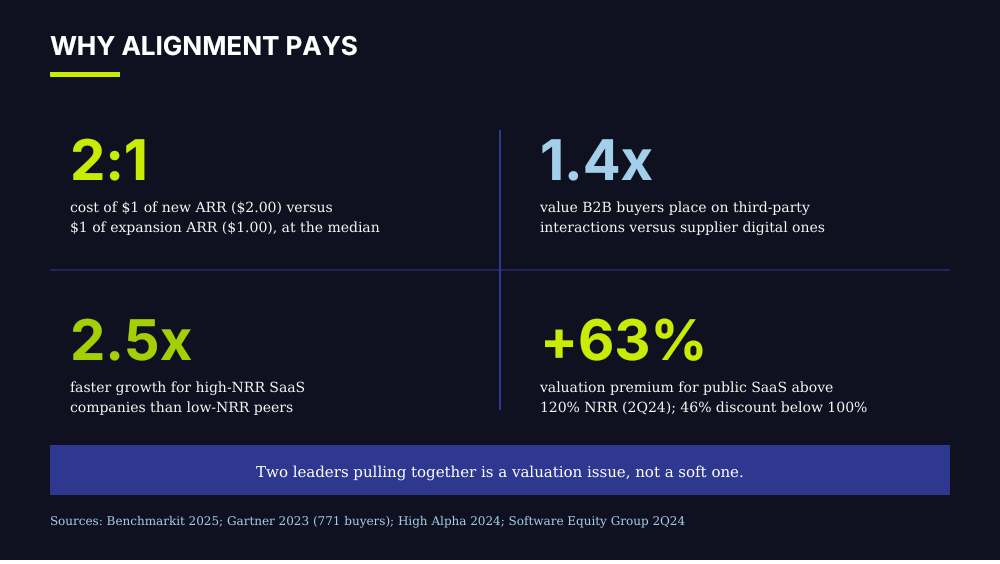
The economics explain why this matters. Benchmarkit's 2025 SaaS Performance Metrics report found that the median company spends about $2.00 of sales and marketing to win each $1.00 of new customer ARR, against a median expansion CAC ratio of $1.00. Every dollar of expansion costs half as much as a dollar of new business. A deal that closes but never expands has therefore captured only the expensive half of its value, and the CRO's number looks healthy while the company's efficiency quietly erodes.
The real bleed, the one that gets every SaaS firm here, is references, or as I refer to them as 'New Gold'.
"The fastest way to improve your new business conversion rate is to make your existing customer base impossible to ignore. Reference-led selling is not a soft commercial motion. It is the highest-ROI activity in your go-to-market strategy."
The buyer research supports the instinct. Gartner's survey of 771 B2B buyers found that buyers value third-party interactions, including reading customer references and reviews, 1.4 times more than digital supplier interactions when it comes to affirming their choice. Forrester's B2B buying surveys name conversations with buyer-sourced and vendor-sourced references among the most popular third-party interactions, and report that the impact of third-party meetings has risen each year. This is also why a stuck onboarding is so costly. Gartner found 77% of buyers describe their latest purchase as complex or difficult, so a customer who struggles through onboarding is unlikely to pick up the phone for your next prospect. I would treat the "highest-ROI activity" line as our operating view from client work. The research shows references matter. It does not rank them against every other go-to-market activity.
The structural fix for revenue leadership alignment
First, they define ICP with a format that can be healthily maintained and reviewed. A deal that falls outside ICP requires explicit sign-off from both the CRO and the CCO.
Second, they create a shared commercial metric. NRR is the only metric that requires both functions to succeed. A business that only measures new ARR has inadvertently built a structural conflict into its commercial leadership.
The data on why NRR deserves that role is strong. SaaS Capital's survey of more than 1,000 private B2B SaaS companies found growth is positively and exponentially correlated with net revenue retention. Moving from the 90 to 100% NRR band to the 100 to 110% band lifts median growth by about 5 percentage points, and the highest-NRR companies grow a median 173% faster than the population median. High Alpha's 2024 SaaS Benchmarks Report, cited in its NRR analysis, found high-NRR SaaS companies grow 2.5 times faster than low-NRR peers.
Third, they make CS part of the sales process, as a revenue leader not a support function, a commercial asset not a cost centre.
In practice that means three small mechanisms. A late-stage deal review where the CCO's team confirms the customer's use case sits inside the product's strength. A shared scorecard on which NRR sits next to new ARR. And a reference pipeline owned jointly, so that the CRO knows which happy customers are ready to speak and the CCO knows when a request is coming.
For PE-backed businesses, this is a board-level revenue leadership alignment issue
The CCO/CRO dynamic is worth examining at board level. I don't personally believe it's a management issue, I do think it's a valuation issue. A business where these two functions are pulling in the same direction will have higher NRR, lower CAC, shorter sales cycles, and a revenue team that attracts and retains great people rather than burning through them.
Forrester's research on aligned customer-facing teams points the same way: its analysis found that firms with strong alignment across those teams achieve 2.4 times the revenue growth of unaligned peers. That research frames alignment across sales, marketing and product rather than CS specifically, and does not publish a sample size, so I would use it as supporting evidence, not proof.
A business where these functions are in silent tension will have the opposite of all those things. And in a market where exit multiples are increasingly driven by revenue quality metrics, the operational health of your commercial leadership dynamic is not a soft management concern. It is a hard financial one. In Software Equity Group's analysis of public SaaS companies, firms with net retention above 120% traded at a 63% premium to the index median, while those below 100% traded at a 46% discount (2Q24 data; the 2Q26 index median is 3.2x, so absolute multiples have compressed while the ordering holds).
New Gold can be found in abundance with a team who are aligned on what their boat needs to look like to face rocky waters. It's likely you are in the boat right now, but if the above triggers you perhaps the real exam question is 'What is being done to make the boat go faster?'
If you would like to talk more about how we can help you fix revenue leadership alignment and develop that 100 day plan please reach out to myself jameslawson@riverconsultancygroup.co.uk or my partner denny.burda@riverconsultancygroup.co.uk or explore more on our website riverconsultancygroup.co.uk
James Lawson is founder of River Consultancy Group, a specialist advisory practice helping PE-backed SaaS businesses identify and unlock growth. He has scaled post-acquisition CS functions from 6 to 63 people and managed a $140M ARR portfolio across global law firms. Connect: linkedin.com/in/jlaw-maketheboatgofaster
Sources referenced:
SaaS Capital, Private B2B SaaS Company Growth Rate Benchmarks
High Alpha, Net Revenue Retention: Why It's Crucial for SaaS Growth in 2025
Forrester, Aligning Around The Customer Will Turbocharge Companies' Growth Engines (February 2023)
Software Equity Group, Net Retention and Public SaaS Valuation (2Q24 data)
Software Equity Group, 2Q26 SaaS M&A and Public Market Report
