
Who touched the thermostat?: Why NRR Is a Post-Sales Design Choice, Not a CS Scorecard
Published on 16 September 2026 • Written by Denny Burda
A revenue operations framework for founder-led and PE-backed SaaS leaders who are ready to stop measuring retention and start engineering it.
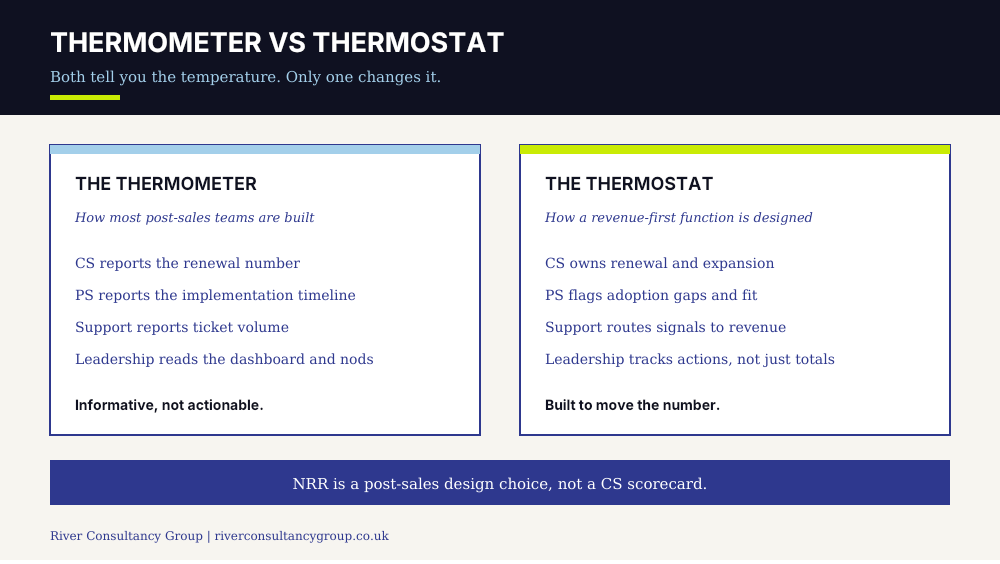
A thermometer and a thermostat both tell you the temperature. Only one of them does anything about it. A thermometer reports. A thermostat acts, constantly adjusting to hold the room at the number you actually want.
Most SaaS companies build their post-sales function as a thermometer. CS reports the renewal number. PS reports the implementation timeline. Support reports the ticket volume. Leadership reads the dashboard, nods, and moves on, because the numbers are informative, not actionable. Nobody on that team was ever built, resourced, or compensated to move the number, only to report it.
A team that only measures the temperature will never be blamed for the room being cold. It will also never be the reason the room gets warmer.
Where "Reporting" Post-Sales Quietly Caps Your NRR
At River, we see the same structural pattern across founder-led and PE-backed SaaS businesses, regardless of size or vertical. Post-sales isn't underperforming. It's underbuilt for the job everyone secretly expects it to do.
CS carries the churn number but not the expansion number. If renewal is the only metric a CSM owns, renewal is the only outcome they'll optimize for, and a saved account and a grown account get scored identically even though only one moves NRR. The expansion opportunity is not small. Benchmarkit's 2025 SaaS Performance Metrics report found existing customers now generate a median 40% of new ARR, up five points in a year, rising to 58% for companies between $50M and $100M ARR. Yet median NRR sits at just 101% and gross revenue retention has slipped from 90% to 88% over three years. The revenue is there. The function that sits closest to it is often not set up to collect it.
PS delivers the implementation and disappears. Professional services teams sit closer to the customer's actual usage and value realization than almost anyone else in the business, yet they're rarely looped into expansion conversations they're best positioned to spot. Benchmarkit puts professional services at about 15% of total revenue at the median, at a median 30% gross margin. That profile tells you how most businesses run the function: as a margin line to protect, not as the front door to the next purchase. Both can be true, but only if someone designs the handoff from go-live to growth.
Support is treated as a cost center, not a signal source. Every support ticket is a data point about where the product is confusing, where a customer is under-adopting a feature they're already paying for, or where an upsell conversation is overdue. Most support functions are resourced to close tickets fast, not to route what they're learning back into revenue motion.
None of these functions are failing at their job. They're succeeding at the job they were structurally given, which was never the job that actually moves NRR.
What the Data Says About Post-Sales as a Revenue Function
This isn't a philosophical distinction. It shows up in how companies measure, own and compensate the function.
On measurement, Gainsight's CS Index report found 76% of companies cite customer retention as a primary revenue metric, and 55% use gross revenue retention as a top measurement of CS performance. Satisfaction scores and ticket counts are no longer the headline. Revenue is.
On ownership, TSIA's State of Customer Growth and Renewal 2025 found that companies are moving low-complexity renewal and upsell work away from account executives and toward customer success and dedicated renewal teams. It links relying on account executives for medium-complexity renewals to about three times higher renewal costs, roughly 10% lower net renewal rates and nearly 10% fewer attached upsells. Earlier TSIA research on expansion and renewal found that customer success teams given a revenue charter see both growth and renewal rates rise, and linked tracking upsells and cross-sells to a nine point improvement in annual revenue per account growth. That article is from 2020 and does not publish its sample size, so treat the magnitude as directional. The direction cuts against the common worry that asking CS to grow accounts undermines their advocacy role.
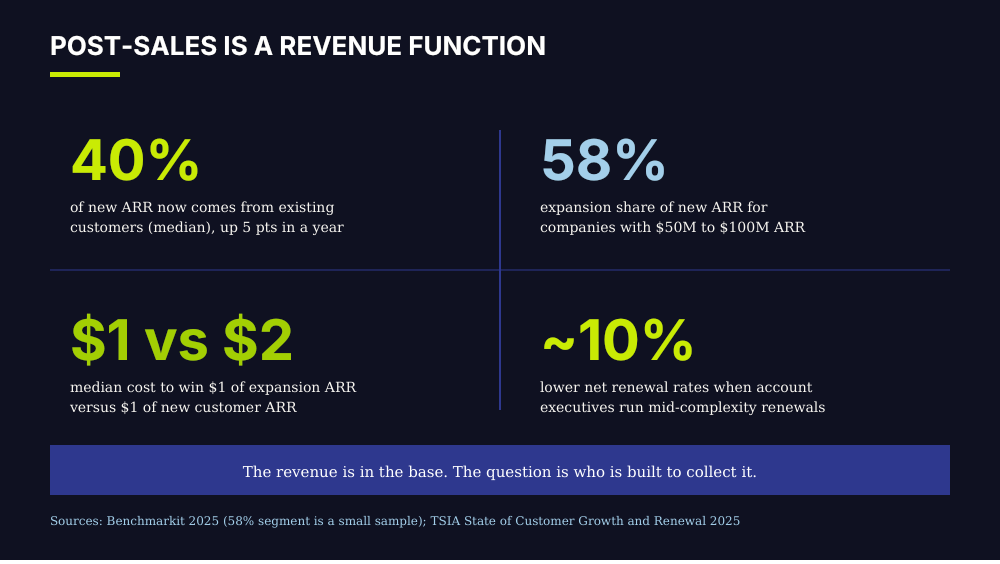
The economics explain the shift. In the same Benchmarkit data, the median expansion CAC ratio is $1.00 of sales and marketing spend per $1.00 of expansion ARR, against $2.00 for new customer ARR. Expansion revenue costs half as much to win, and the people best placed to win it are already in the account. Managing that function as a cost center, rather than resourcing and incentivizing it like a revenue function, is a structural gap, not a performance problem.
Companies don't get a high-NRR post-sales motion by hiring better CSMs. They get it by building a function that's structurally allowed to move the number it's held accountable for.
Fixing NRR Means Redesigning the Function, Not Coaching the Team
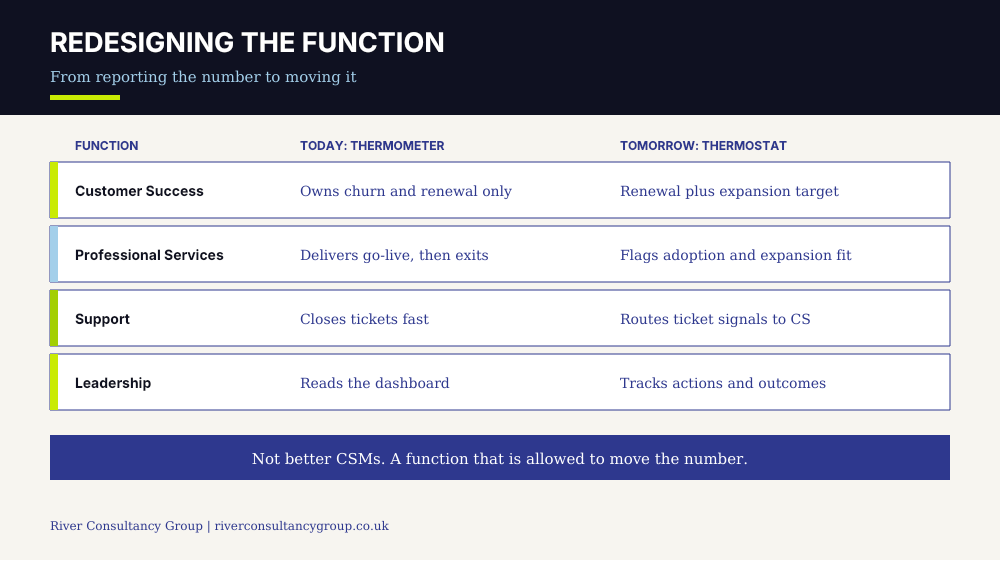
NRR isn't a scorecard CS reports on. It's an output of how deliberately Sales, CS, PS, and Support are structured, incentivized, and connected to act on what they see, not just observe it. In practice, a thermostat design looks like this:
CS: an expansion or qualified-opportunity target alongside renewal, with a clear rule for when an account moves to a sales-assisted conversation.
PS: a defined go-live review where the implementation lead flags adoption gaps and expansion fit to the account owner, with credit for what follows.
Support: a short list of ticket patterns that trigger a revenue action, such as repeated questions about a feature the customer already pays for, routed to CS on the same day.
Leadership: a dashboard that shows actions taken and outcomes, not only the number.
Revenue Enablement Training: Turning Post-Sales Into a Revenue Function
Our Revenue Enablement Training programme is built for exactly this shift, upskilling CS, PS, and Support to operate with the commercial fluency and role-specific tools to influence expansion, not just report churn. Delivered online and onsite, it's practical, role-specific training designed for immediate application, not generic soft-skills coaching bolted onto a support team's existing workload.
We're recently delivered this programme with Younium, the Swedish subscription billing platform, upskilling their post-sales teams to operate with a revenue-first mindset across CS, PS, and Support.
If you'd like to talk about redesigning post-sales into a function that moves NRR rather than reports it, reach out to me at denny.burda@riverconsultancygroup.co.uk or my partner James at jameslawson@riverconsultancygroup.co.uk, or explore more at riverconsultancygroup.co.uk.
Denny Burda is CCO of River Consultancy Group and creator of the Revenue Strategy Lab. He has led revenue teams to sustained growth across founder-led and PE-backed SaaS businesses. Connect with Denny at linkedin.com/in/dennyburda.
Sources referenced:
