
Your Exit Starts 3 Years Out, Not 12 Months: Building the SaaS Exit Readiness Narrative Buyers Will Pay a Premium For
Published on 30 September 2026 • Written by James Lawson
A practical guide to SaaS exit readiness, buyer diligence, and the PE exit strategy work that separates a good multiple from a great one.
Preparing a SaaS business for exit is not a twelve-month exercise. The businesses that achieve the best multiples started building their exit narrative years before the process began. Here is what that looks like and what to avoid so that your business doesn't leave money on the table.
My track record with exits is quite frankly all over the place. I've been part of 14 in total, in some of which I have held equity, in others not. Most of my involvement has revolved around a version of exit preparation that most PE-backed SaaS businesses will recognise. Roughly eighteen months before exit, the investment committee starts focusing on EBITDA margins. Twelve months out, the finance team begins cleaning up the numbers. Around six months out, the commercial team is told to show some exciting pipeline. Then, suddenly, from nowhere, around three months out the Information Memorandum (IM) gets written.
I'm not saying the process is wrong. But observationally, it is always late. And it tends to produce exit materials that look like a polished version of what the business has always been, rather than a compelling story about what the business is becoming.
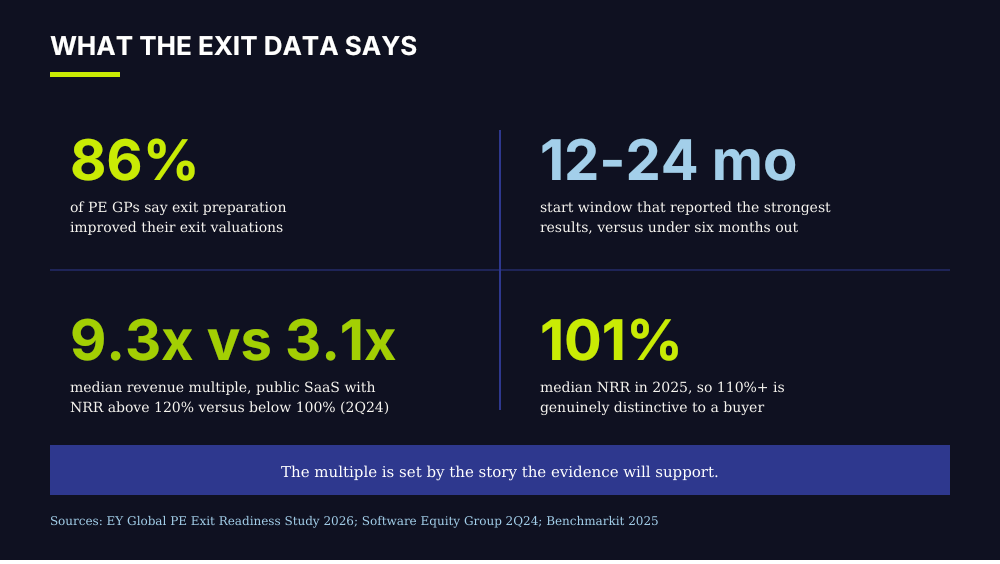
The data points the same way. EY's 2026 Global PE Exit Readiness Study, based on 100 PE executives and 100 executives from recently exited portfolio companies, found that firms starting preparation 12 to 24 months before a sale reported the strongest results, with around half saying it improved outcomes "much" or "a great deal". Firms that started less than six months out mostly reported only moderate improvement. And 86% of GPs said exit preparation initiatives improved their exit valuations. That is the benefit of starting at the 12 to 24 month mark. In my experience, the businesses with the best multiples started earlier still, because the commercial evidence a buyer wants takes longer than two years to build credibly.
In every case in my experience, the businesses that command the best multiples are the ones where the exit narrative has been actively constructed for two to three years before the process starts, and where SaaS exit readiness has been treated as an operating discipline, not a paperwork exercise.
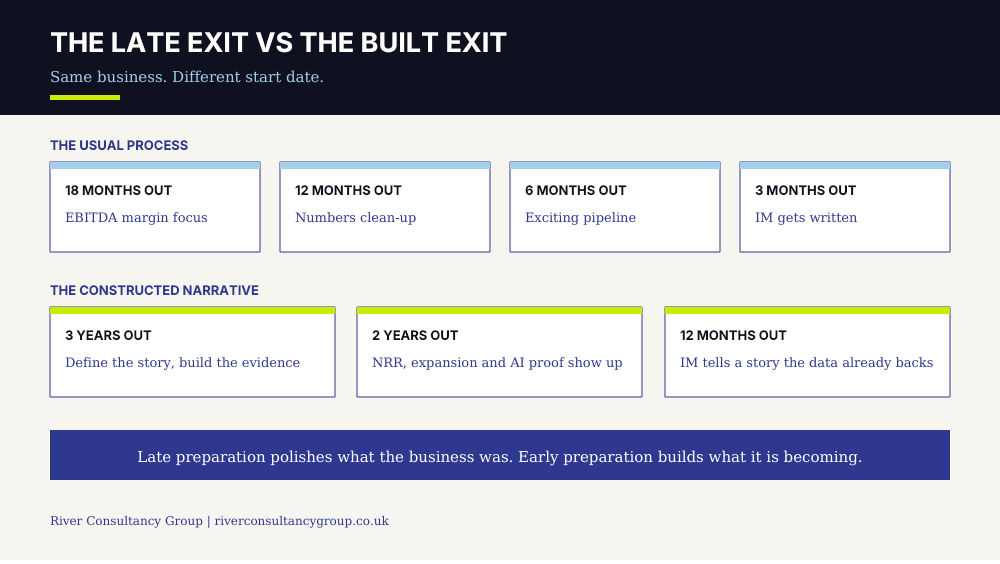
What a constructed SaaS exit readiness narrative looks like
A constructed exit narrative starts with a simple question: what story will a strategic buyer or growth equity investor find most compelling about this business in three years? Then reverse engineer it to identify what operational and commercial evidence needs to exist to support that story, the evidence that holds up under real buyer diligence.
The most valuable SaaS exit narratives in the current market share several characteristics.
Demonstrable AI capability with EBITDA evidence. Not a roadmap, but specific examples of where AI has reduced operational cost or improved commercial outcomes, with numbers attached. RSM's guidance for PE diligence makes the same test: validated use cases with "a measurable line of sight to EBITDA in six months or less".
Net revenue retention above 110%. For me, this is one of the most powerful exit metrics for a SaaS business because it demonstrates that the business grows without new customers. The market prices it. In Software Equity Group's mid-2024 public SaaS data, companies with NRR above 120% traded at a median of 9.3x revenue, while those below 100% traded at 3.1x. SaaS Capital's valuation model for private companies uses NRR alongside growth as one of its three inputs. Benchmarkit's 2025 data puts the median NRR at only 101%, so a business at 110% or more is genuinely distinctive.
A scalable commercial model. Evidence that the cost of acquiring and retaining each incremental amount of ARR is decreasing, not increasing.
Operational maturity. As many standardised processes as possible, documented playbooks, and a management team that does not depend on one or two key individuals.
A clear land-and-expand motion. Evidence that the business knows how to enter an account and grow it. In my experience, logo-only businesses sell for less than businesses with proven expansion engines.
"The multiple you achieve at exit is set by the story a buyer believes about the next three years, not by the financial performance of the last three. Build for the story they need to tell their investment committee."
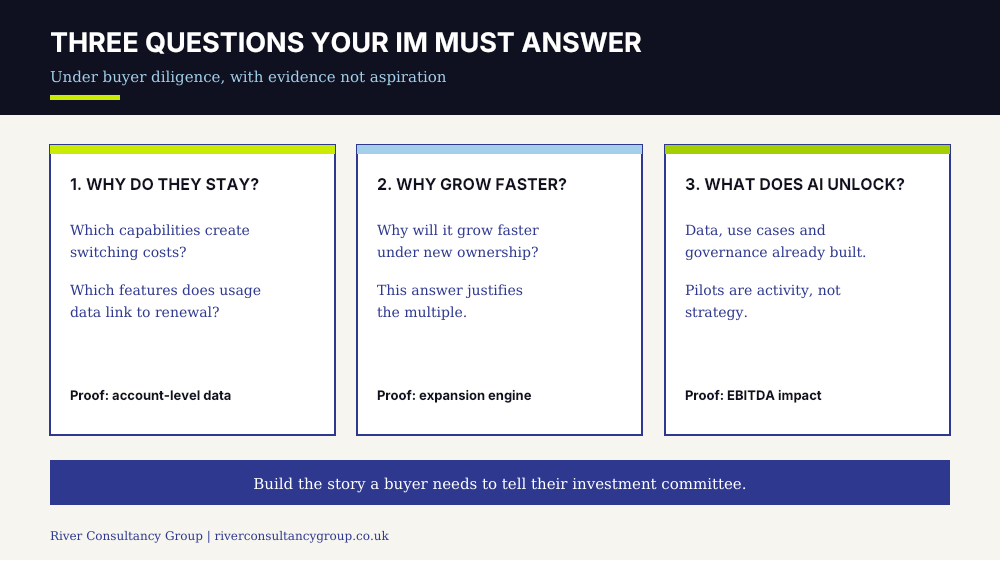
The three questions your exit IM needs to answer under buyer diligence
Why and how are customers staying? Specifically, which product capabilities are creating the switching cost that makes customers renew? What does the usage data show about the features that drive retention? The EY study found that data and KPI readiness is still the top finance-function challenge in exit preparation, cited by 60% of GPs, and that companies often lack the customer- or segment-level data needed to support their equity story. If you cannot show this at account level, you cannot evidence it.
Why will the business grow faster under new ownership? This is the question that justifies the multiple the most. It requires an evidenced answer, not something aspirational.
What does AI unlock? In 2026, every serious buyer of a B2B SaaS business will have an AI diligence workstream as part of their broader process. KPMG's 2026 Global M&A Outlook, a survey of 700 senior dealmakers, found 56% using agentic AI in due diligence and valuation, which means the buyer's own analysis is getting faster and deeper. The EY study found that buyers now distinguish AI activity (pilots and isolated tools) from AI strategy (embedded use, measured benefits, governance and scalable adoption), and that weak data makes AI claims hard to evidence, which can mean deeper scrutiny, longer timelines and valuation pressure. The businesses that have already built the data infrastructure, the use cases and the governance framework will have a material advantage in that conversation.
Starting earlier than feels necessary for SaaS exit readiness
The most common objection I hear when raising exit preparation with management teams who are three or four years from a likely exit is: "It's too early to be thinking about that."
It never is. The operational changes that produce the most compelling exit narratives all take eighteen to thirty-six months to show up credibly in the numbers. Retention, expansion and unit economics are slow variables. You cannot fix a cohort curve in a quarter.
On the multiple itself, I want to be careful. The range is wide and depends on size, growth, retention and sector. Public datasets put the private SaaS median somewhere between roughly 3x and 5x revenue depending on deal size and source (SaasRise's Q1 2026 review collates a range of 3.1x to 5.3x), and well-run, high-retention businesses sit well above that. What I have seen across the exits I have worked on is a consistent gap: the businesses that waited until twelve months out to think about their commercial narrative sold at the low end of their range, and the ones that started three years out, with consistent execution and the data to prove it, sold at the top of it. That is my observation, not a published benchmark. But the direction is supported by what buyers say they test.
If you would like to talk about how we can help you build SaaS exit readiness and develop that 100 day plan, reach out to me at jameslawson@riverconsultancygroup.co.uk or my partner Denny at denny.burda@riverconsultancygroup.co.uk, or explore more at riverconsultancygroup.co.uk.
James Lawson is founder of River Consultancy Group, a specialist advisory practice helping PE-backed SaaS businesses identify and unlock growth. He has scaled post-acquisition CS functions from 6 to 63 people and managed a $140M ARR portfolio across global law firms. Connect: linkedin.com/in/jlaw-maketheboatgofaster
Sources referenced:
RSM, Artificial intelligence: Ready or not? (AI due diligence for PE)
SaasRise, Private SaaS M&A Deals Q1 2026 Report (secondary compilation of Aventis, Windsor Drake and others)
