
Published on 25 November 2026 • Written by Denny Burda
A look inside the Revenue Strategy Lab methodology, for founders and boards who want to know what "embedded" actually means before they commit to it.
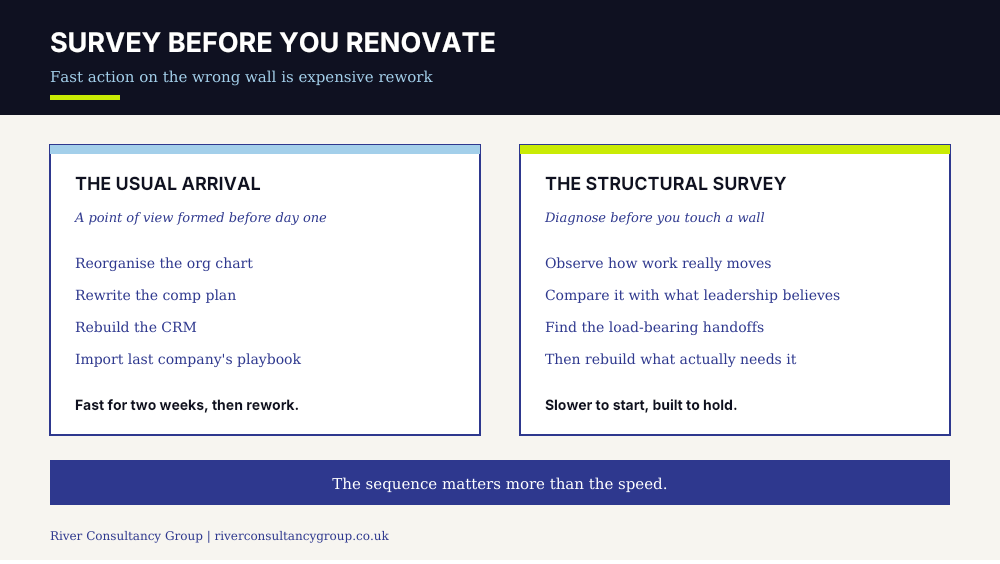
Before a good architect draws a single wall on a renovation, they commission a structural survey. Which walls are load-bearing. Where the wiring actually runs, not where the plans say it runs. Which parts of the foundation are sound and which have been quietly compromised for years. Skip that step and the renovation looks fast for about two weeks, right up until a contractor opens a wall and finds the real problem behind it.
Most revenue engagements skip the survey. A new hire, an advisor or a consultant arrives with a point of view already formed and starts rearranging the org chart, the comp plan or the CRM before they understand which parts of the business are load-bearing and which just look that way from the outside. The Revenue Strategy Lab is built specifically to not do that.
Fast action on the wrong wall isn't progress. It's just expensive rework wearing the costume of momentum.
Where the Diagnose-First Idea Comes From
The framing isn't unique to us. Harvard Business School professor Michael Watkins, whose book The First 90 Days has shaped how most serious executive onboarding is structured, builds his approach on diagnosing the situation before choosing the strategy. His STARS model sorts a leader's situation into start-up, turnaround, accelerated growth, realignment or sustaining success, and the first of his "five conversations" is with your boss to agree which one you are in. IMD's program, which Watkins leads, starts with an "assess the situation" stage covering the business challenges, the team, the culture and the stakeholder environment, and one participant describes its value as "avoiding coming in with 'the' answers and acting impulsively". Watkins calls the biggest trap "assuming that what made you successful in previous roles is going to make you successful in the new role."
To be precise about what that is: it is a practitioner framework built from work with leaders in transition, not a controlled study with a measured success rate, and Watkins himself advocates securing early wins within the first 90 days. The point is that early wins should fit the situation you have diagnosed. That is the shape we apply, adapted for an embedded engagement rather than a solo executive transition.
What the First 90 Days Actually Produce
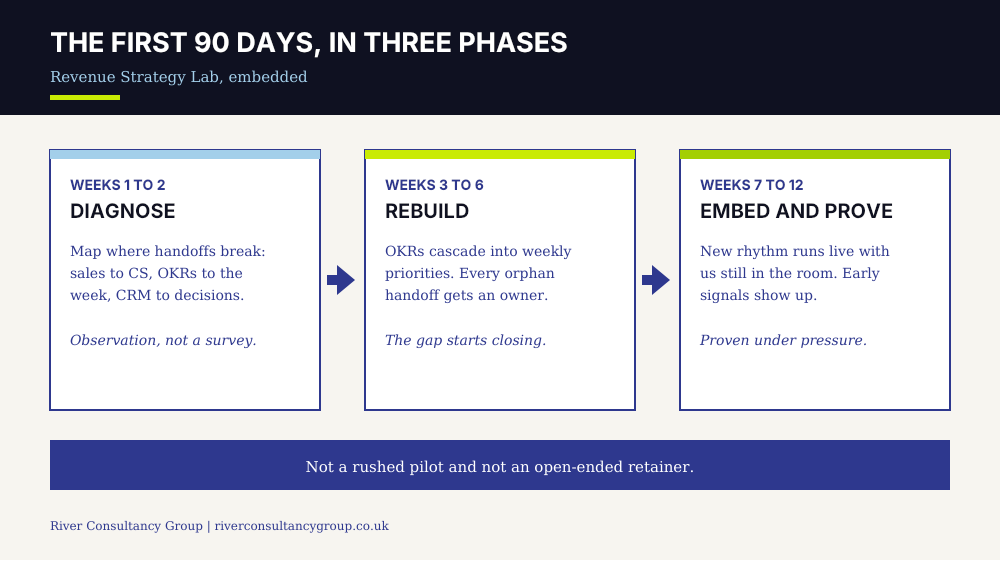
Weeks 1 to 2, diagnosis. We map where the handoffs are actually breaking: sales to CS, OKRs to weekly execution, CRM to decision-making, the same pattern we've written about before. Not a survey. Direct observation of how work actually moves through the business, compared with how leadership believes it moves.
Weeks 3 to 6, rebuild. OKRs get rebuilt so they cascade into what individual teams prioritise week to week, not just what's on a quarterly slide. Ownership gets assigned at every handoff that was previously nobody's job. This is the phase where the gap between strategy and execution starts closing, visibly.
Weeks 7 to 12, embed and prove. The new operating rhythm runs live, inside the business, with us still in the room. Early signals show up here: an improved qualification rate, a cleaner sales-to-CS handoff, an OKR that's actually showing up in a rep's Monday priorities. Not because the quarter is over, but because the infrastructure underneath it changed.
Ninety days isn't a deadline we impose. It's roughly how long it takes to diagnose accurately, rebuild deliberately and prove the rebuild holds under real operating pressure. Not a rushed pilot and not an open-ended retainer.
Why the Sequence Matters More Than the Speed
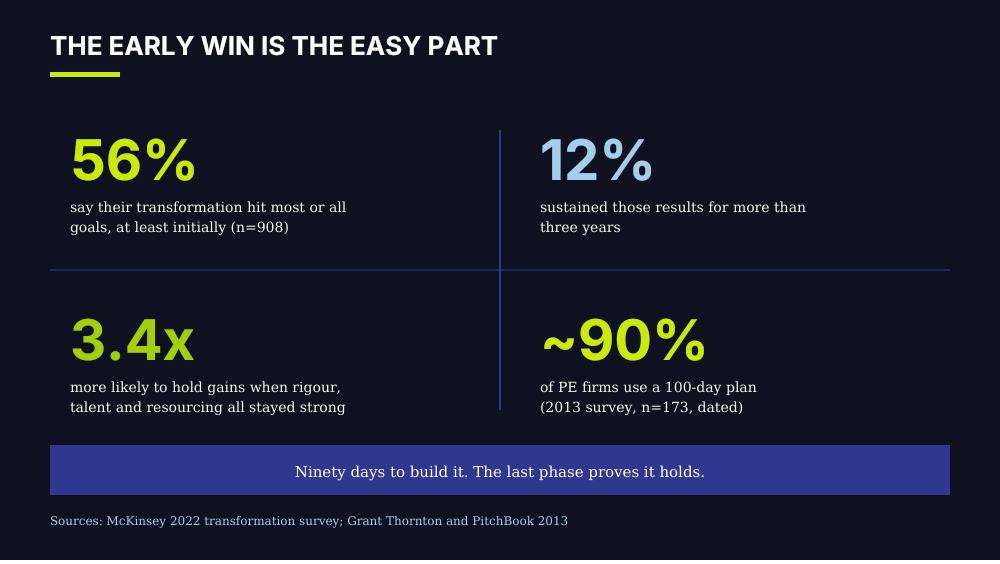
The evidence on large-scale change explains why the "prove it holds" phase exists. McKinsey's 2022 global survey of 908 people, 758 of whom had been through a transformation in the previous five years, found that 56% said their transformation achieved most or all of its performance goals, at least initially. Only 12% said they sustained those results for more than three years. The organisations that did sustain them kept implementation rigour high in the later stages, built capability in their people and committed the right resources at every stage, and those that did all three were 3.4 times more likely to hold their gains. McKinsey's work is not about diagnosis specifically, so I am not claiming it proves our sequence. What it shows is that the visible early result is the easy part, and holding it is where most programmes fall short. That is why our final phase runs the new rhythm live, with us still in the room.
The private equity world has long run on the same logic. A Grant Thornton and PitchBook survey of 173 PE professionals found that almost 90% of PE firms use a 100-day plan, and that management pushback, inadequate internal resources and underestimated complexity were the common reasons implementation slipped. That survey is from 2013, so treat it as evidence of how long the practice has been standard rather than as a current benchmark.
The risk of skipping the diagnosis is higher, not lower, in an embedded engagement, because an outside operator without a genuine diagnosis is even more likely to import a playbook from their last company that doesn't fit this one. This is also why the Revenue Strategy Lab is built on a genuine diagnostic phase rather than a pre-formed playbook, whether you're engaging it as our flagship standalone program or as the methodology running underneath an embedded Fractional Growth Partner engagement. The sequence is the same either way: diagnose before you touch a wall.
Five Questions to Ask Any Embedded Provider
If you are comparing options, these are the questions I would ask of us or anyone else.
What will you observe in the first two weeks, and how will it differ from what leadership has told you?
At which handoffs will ownership change, and who is named as the owner?
What early signal will tell us by week 12 that the change is holding, and who measures it?
What happens to the rhythm when you leave?
What would make you recommend we do less than we asked for?
What This Looks Like for Your Business
If you're evaluating what an embedded engagement would actually involve, whether that's ahead of a leadership decision, a PE-backed portfolio review, or simply because growth has stalled somewhere you can't quite locate, the diagnostic phase above is exactly where we'd start. No pre-formed point of view, no rearranged org chart in week one.
Reach out to me at denny.burda@riverconsultancygroup.co.uk or my partner James at jameslawson@riverconsultancygroup.co.uk, or explore more at riverconsultancygroup.co.uk.
Denny Burda is CCO of River Consultancy Group and creator of the Revenue Strategy Lab. He has led revenue teams to sustained growth across founder-led and PE-backed SaaS businesses. Connect with Denny at linkedin.com/in/dennyburda.
Sources referenced:
IMD, The First 90 Days: Career Transition Program (Michael Watkins)
Michael Watkins, The First 90 Days (Harvard Business Review Press; a practitioner framework, not a quantified study)
McKinsey, How to Implement Transformations for Long-Term Impact (2022 survey, n=908)
Grant Thornton and PitchBook, What Can Be Done in 100 Days? (2013, n=173)
