The AI Agent Trap: Why Most SaaS Businesses Are Automating the Wrong Things
Published on 28 October 2026 • Written by James Lawson
What genuine AI ROI in SaaS customer experience automation actually looks like, and why EBITDA impact of AI beats headcount optics.
The race to deploy AI agents inside SaaS businesses is accelerating. But the businesses achieving meaningful EBITDA impact from AI are not the ones moving fastest. They are the ones who asked a harder question first: what should we not automate?
There is an anti-vision I am witnessing become increasingly popular when it comes to AI adoption in SaaS. It's sweeping through SaaS businesses right now, and it looks like a vision that makes more sense than it should.
I want to be careful here, because I am not anti-AI. I have used AI-assisted workflows to reduce cost of acquisition by 59% and accelerate revenue generation in ways that were not possible eighteen months ago.
The technology tends to work. But the deployment model most businesses are following is producing a specific kind of failure that I am seeing with increasing frequency.
It's called the automation trap. It goes like this: a SaaS business identifies a repetitive, high-volume task, such as support tickets, onboarding emails or renewal reminders, and automates it with an AI agent. The cost saving is immediate. The headcount reduction looks good in the board pack. And then, quietly, over the following six months, something else happens.
A Gremlin Is Born
The customers who used to receive a human response to their support query start to notice that something has changed. The nuance is gone. The sense that someone at the vendor cares whether their problem is resolved is dissolving.
For tier-one queries with clear, binary answers, this no longer seems to matter. For everything else, and "everything else" represents a larger share of your support volume than most businesses track, the automation creates a new category of problem: customers who are technically served but emotionally disengaged.
I've been down this road already and I can tell you that emotionally disengaged customers do not advocate for your product. They rarely expand their contracts, and good luck getting them to provide a reference call.
The wider market has started to say the same thing, and some of the best-resourced companies learned it the expensive way.
Klarna was the poster child. In early 2024 it claimed its AI assistant was doing the work of 700 customer service agents and had handled 75% of customer chats within a month of launch. By May 2025 its CEO, Sebastian Siemiatkowski, told Bloomberg that the AI route had produced "lower quality" and that the company was hiring human support staff again. In his words, "investing in the quality of human support is the way of the future for us."
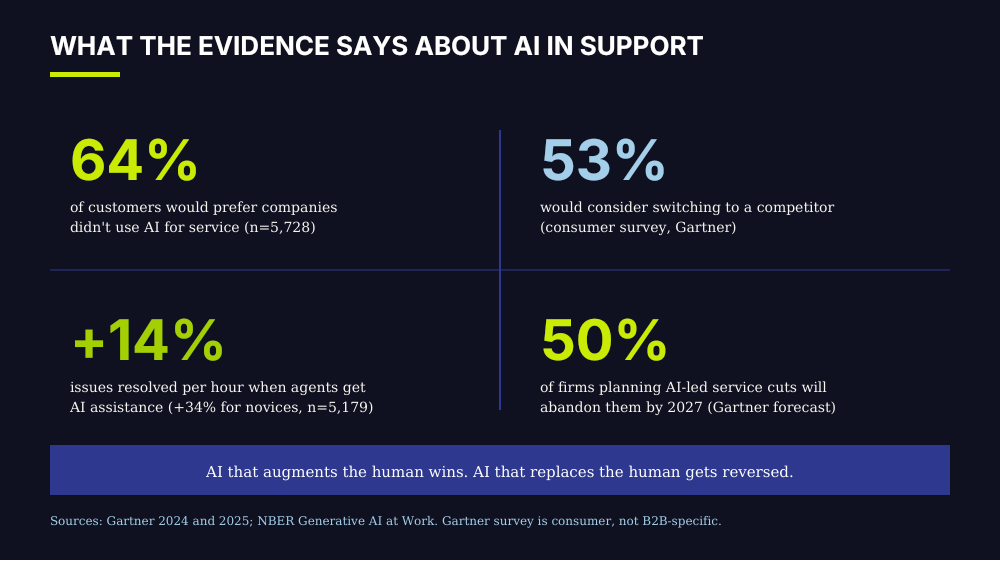
Gartner's survey of 5,728 customers (fieldwork December 2023) found that 64% would prefer companies didn't use AI for customer service, and 53% would consider switching to a competitor. That is a consumer survey, so it overstates the risk for a B2B enterprise account that already has a named CSM. But it shows where customer sentiment starts.
Gartner's 2025 prediction is that by 2027, half of the organisations that planned to significantly cut their customer service workforce because of AI will abandon those plans. A supporting survey of 163 service leaders found that 95% plan to keep human agents to define AI's role. It is a forecast, not a measured outcome, but it comes from leaders who are living this decision.
"Automating a customer touchpoint is not the same as improving it. The question is not 'can AI do this?' It is 'should the human element here be removed, and what do we lose if it is?'"
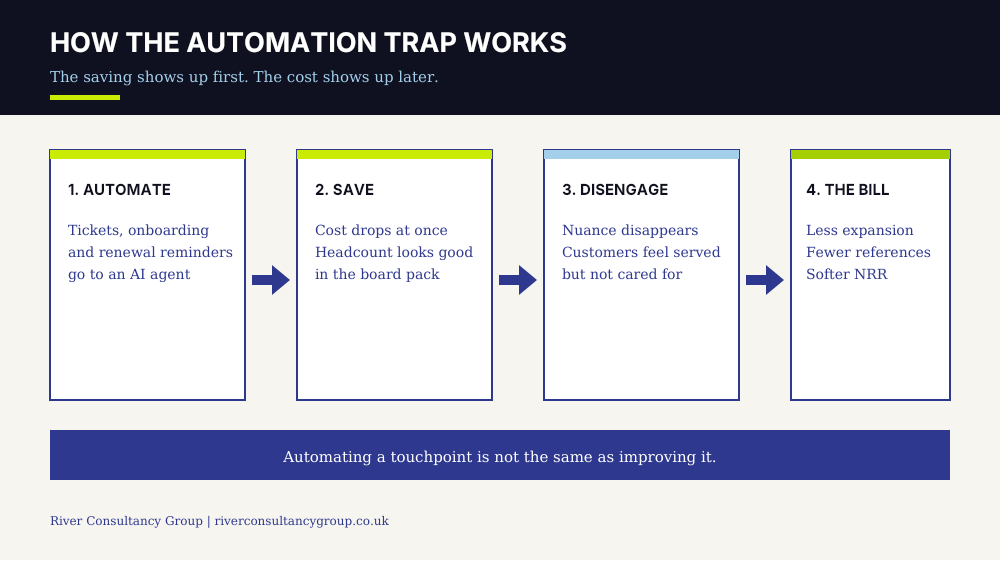
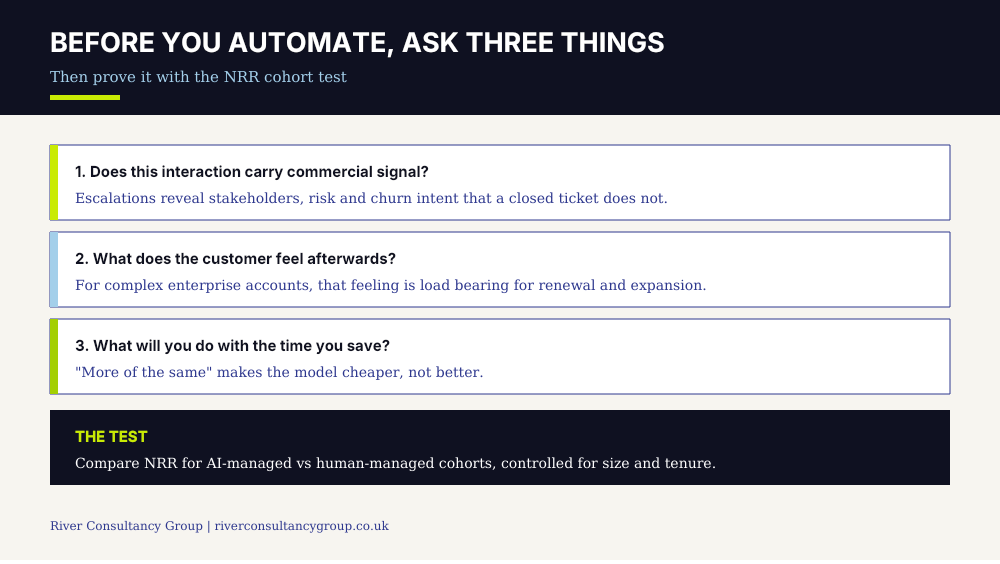
The three questions to ask before any SaaS customer experience automation project
Does this interaction carry commercial signal? Support tickets, renewal conversations and onboarding check-ins are not just service touchpoints. A human CSM who handles a difficult support escalation learns something about the customer's business, their stakeholder dynamics and their risk of churn that an AI resolution ticket does not capture.
What does the customer feel after this interaction? For high-value, high-complexity enterprise accounts, that emotional dimension is load bearing. Automate it away and you will see it in your NRR within twelve months, or less. NRR is where this lands, and it is where buyers look: Benchmarkit's 2025 data puts median NRR at 101% and median gross revenue retention at 88%, so there is not much margin to give away.
What are you doing with the time you save? This is the question most AI deployment plans fail to answer. If the answer is "more of the same", you have not improved the commercial model. You have just made it cheaper.
Where AI genuinely transforms SaaS operations and drives AI ROI
The highest-value AI deployments I have seen share a common characteristic: they augment human judgement rather than replace it. The AI surfaces the signal, whether that is the customer who is disengaging, the account that is ready to expand or the onboarding step where drop-off is highest. The human makes the decision and has the conversation.
The best published evidence points the same way. A study by Brynjolfsson, Li and Raymond of 5,179 customer support agents found that giving agents a generative AI assistant raised productivity, measured as issues resolved per hour, by about 14% on average, and by about 34% for novice and low-skilled workers, with minimal impact on the most experienced. The paper also reports improved customer sentiment and higher agent retention. That is AI as an amplifier of human judgement, and it is the model I am arguing for.
On the CS side, Gainsight's CS Index found 52% of companies integrating AI into their workflows, with the main use cases being churn prediction, task automation and analytics that surface behaviour trends. Note what the report does and does not say: it describes time saved and earlier warning, but it does not publish a measured effect of AI on retention. Nobody has yet shown that replacing CS with agents lifts NRR, which is precisely why the test below matters.
That is the AI adoption story that commands a premium at exit. Not "we replaced our CS team with bots", but "our team is three times more commercially productive than it was two years ago, and here is the NRR data to prove it."
A practical starting point for measuring EBITDA impact of AI
If you are currently planning or have recently deployed AI agents across customer-facing functions in your SaaS business, I would suggest one diagnostic exercise before the next board meeting. Pull the NRR data for the cohort of customers who have had their primary interactions managed by AI agents versus those who still have dedicated human CSMs. Control for account size and tenure, or the comparison will mislead you. The result will tell you whether your automation is creating value or just reducing cost.
I promise you this. You look very different at exit if you do.
If you would like to talk more about how we can help you audit your AI ROI and develop that 100 day plan, please reach out to me at jameslawson@riverconsultancygroup.co.uk or my partner Denny at denny.burda@riverconsultancygroup.co.uk, or explore more at riverconsultancygroup.co.uk.
James Lawson is founder of River Consultancy Group, a specialist advisory practice helping PE-backed SaaS businesses identify and unlock growth. He has scaled post-acquisition CS functions from 6 to 63 people and managed a $140M ARR portfolio across global law firms. Connect: linkedin.com/in/jlaw-maketheboatgofaster