Full Time, Fractional, Or Not Yet. What Founders get wrong about the CRO Hire
Published on 14 October 2026 • Written by Denny Burda
When a football club loses its manager mid-season, the board rarely hands the job straight to a permanent successor. They appoint a caretaker. Someone senior enough to run first-team affairs immediately, for a defined stretch, while the club works out exactly what the next permanent appointment needs to fix: squad rebuild, tactical identity, boardroom relationships. Only then do they commit to a multi-year contract. The caretaker isn't a consolation hire. It's the deliberate choice that stops the club from making a five-year decision in the middle of a crisis.
Most SaaS founders don't think of a caretaker option when the revenue leadership gap opens up. They see two choices: hire a full-time CRO now, or leave the gap unfilled and hope the team figures it out. Both instincts come from the same place, urgency, and urgency is exactly the wrong condition under which to make a role this consequential.
A football club would never hand a five-year contract to whoever's available the week the manager walks. Most SaaS boards do the equivalent every time.
The Two Ways Founders Get This Hire Wrong
At River, we see this play out in one of two directions, and both are more common than a clean, well-timed full-time hire.
Hiring too early, at too much seniority, for a business that doesn't have the infrastructure for them to lead yet. A founder brings in a full-time CRO to fix a growth problem, but the underlying issue is the execution gap we've written about before: the handoffs between sales, CS and OKRs that nobody owns. A CRO dropped into that environment spends their first six months rebuilding foundational infrastructure that a fractional or interim leader could have built faster, at a fraction of the cost, without the company committing to a permanent seat before it understood what the seat needed to do.
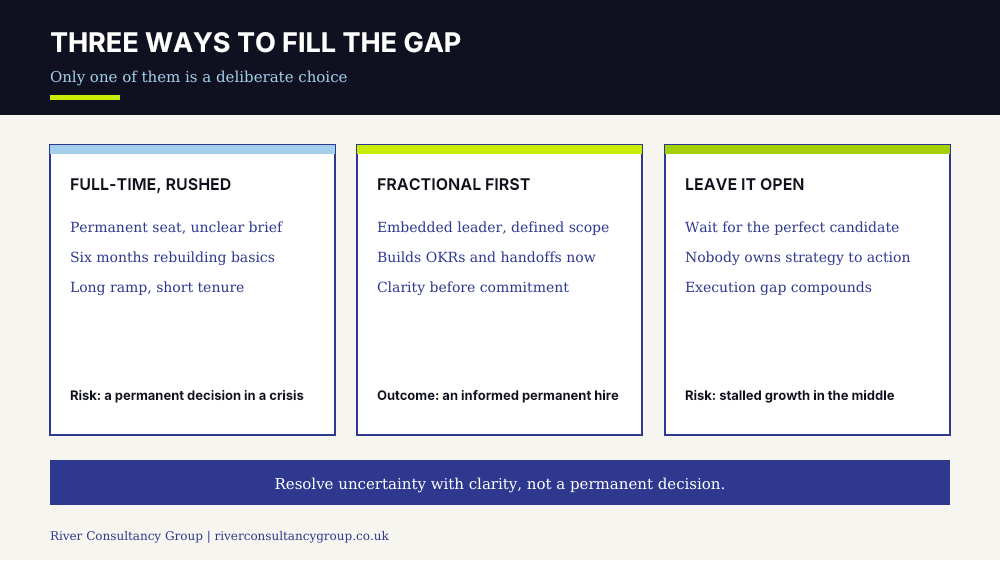
Leaving the gap unfilled too long. The opposite instinct is waiting for the "perfect" candidate or the "right time" to make a senior hire, while growth quietly stalls in the middle layer because nobody owns the exchange between strategy and execution. This is the same execution gap, left to compound for longer.
Neither instinct is really about the hire. Both are about trying to resolve uncertainty with a decision that's permanent, when what the business needs first is clarity.
What the Data Says About Revenue Leadership Tenure
The evidence on how long revenue leaders stay is consistent, even if the sources vary in quality.
The most recent large dataset comes from Pave's compensation database, analysed by SaaStr in 2025. Across roughly 14,000 executives, both CMOs and CROs averaged just 1.8 years in role. The Bridge Group's CRO Research Project, which surveyed 145 senior B2B SaaS sales executives and was summarised by Blossom Street Ventures in 2020, reached almost the same conclusion: average CRO tenure of just under two years. Two different datasets, five years apart, one answer.
Smaller studies point the same way. A Big Byte analysis of 30 investor-backed German SaaS companies found that 72.6% of past commercial leaders (82 of 113) had stayed under two years, and 34.5% under one, with average commercial leadership churn of about 40% over five years. That is a small, regional sample, so treat it as directional.
Now set tenure against ramp time. Talentfoot's SaaS executive benchmarks cite nine to twelve months for a CRO to reach measurable impact. Their source is described only as practitioner surveys, so this is a rule of thumb, not a hard benchmark. But apply it to a 1.8-year average tenure, roughly 21 months, and the arithmetic is uncomfortable: if the ramp takes nine to twelve months, around half of an average CRO's time in the seat is spent getting up to speed. That is not the same as saying most CROs leave before they ramp. It means the business is paying for a long runway and getting a short flight, and a hire made under pressure, without a clear brief, makes that ratio worse.
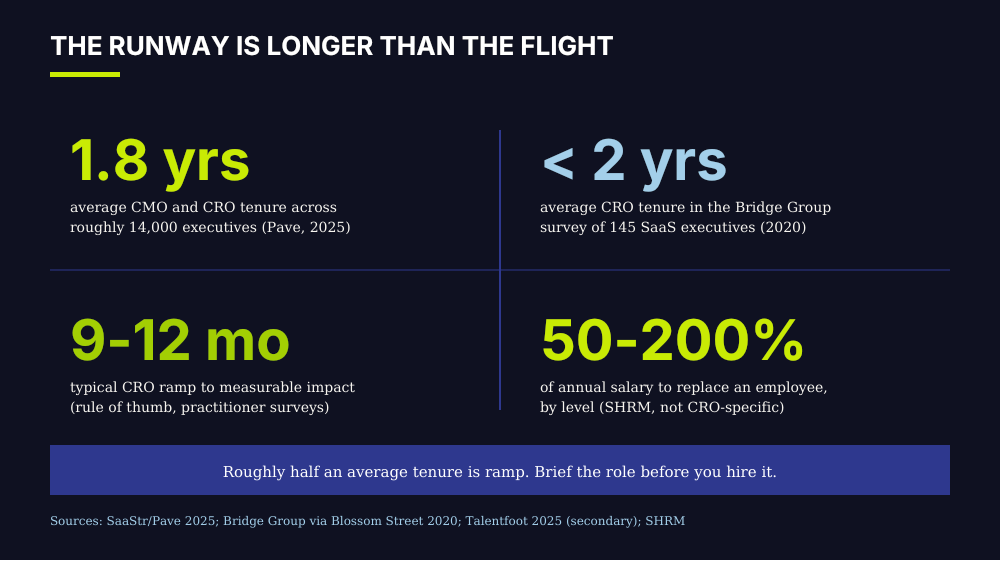
The cost of replacing the hire is real too, though precise executive figures are hard to find. SHRM guidance puts the cost of replacing an employee at 50% to 200% of annual salary, depending on level. SHRM does not give a specific figure for CROs, so read the top of that range as an upper bound for senior roles, not a CRO-specific benchmark. Talentfoot adds that retained search fees typically run 20% to 35% of first-year compensation before onboarding delay and team disruption are counted.
On the other side of the equation, the fractional model is growing, but I would be careful with the statistics being quoted around it. The widely repeated forecast that more than 30% of midsize enterprises will have a fractional executive on retainer by 2027 is attributed to Gartner in several articles, but I could not trace it to a Gartner publication, so I have not used it here. Adoption data for fractional leadership is largely vendor-reported and inconsistently defined. The direction is clear from what we see in the market. The precise numbers are not yet reliable enough to build a board case on.
The full-time CRO hire isn't wrong. It's wrong when it's the first move instead of the informed one.
Full-Time, Fractional, or Not Yet: A Simple Test
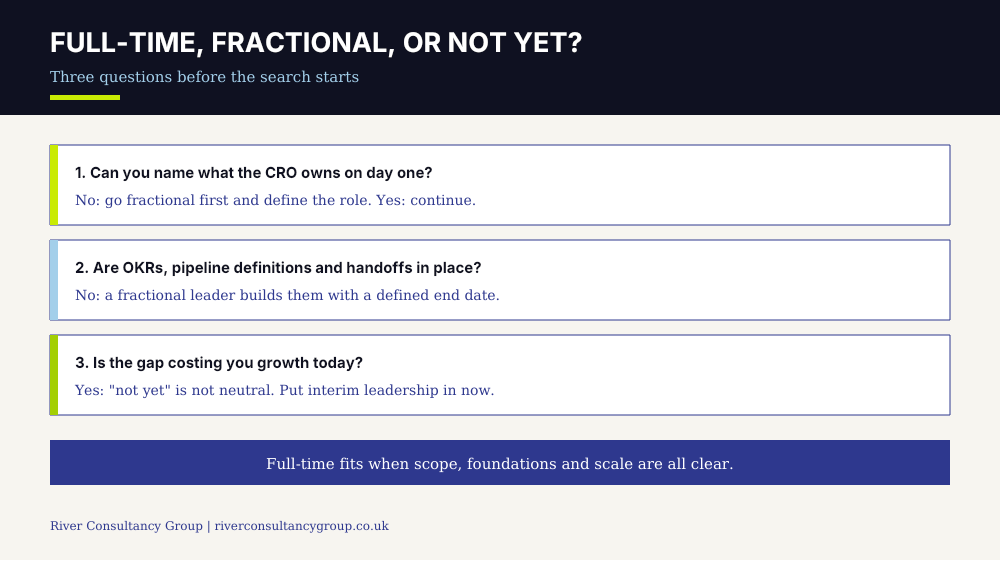
The right sequence isn't full-time versus nothing. It's building clarity on what the role needs to do before committing to a permanent seat. In practice, the decision tends to follow three questions.
Do you know what the CRO would own on day one? If you can't name the three or four outcomes, the handoffs, targets and systems the role is responsible for, you are hiring against a feeling. That points to fractional first.
Is the infrastructure there to lead? If OKRs, pipeline definitions and the sales-to-CS handoff are still undefined, a full-time CRO will spend their first six months building them. A fractional leader can do that work with a defined end date.
Is the gap costing you now? If growth is stalling in the middle layer today, "not yet" is not a neutral answer. Waiting has a price. The deliberate choice is to put interim leadership in place while you decide on the permanent shape of the role.
A full-time CRO is the right answer when the answers to those questions are clear: defined scope, working foundations and a business large enough to keep a full-time leader fully deployed. It is the wrong first move when they are not.
The Fractional Growth Partner: The Deliberate Middle Path
Our Fractional Growth Partner offering exists for exactly this moment: embedded senior revenue leadership, priced per committed day per week per month, with a defined scope and a defined exit. It is not an open-ended advisory relationship and not a premature permanent hire. It gives founders and boards the clarity a rushed full-time search can't, while the Revenue Strategy Lab methodology rebuilds the execution infrastructure a new CRO would otherwise spend their first six months discovering.
If you're weighing a full-time revenue leadership hire and want to make that decision with more clarity, not less time pressure, reach out to me at denny.burda@riverconsultancygroup.co.uk or my partner James at jameslawson@riverconsultancygroup.co.uk, or explore more at riverconsultancygroup.co.uk.
Denny Burda is CCO of River Consultancy Group and creator of the Revenue Strategy Lab. He has led revenue teams to sustained growth across founder-led and PE-backed SaaS businesses. Connect with Denny at linkedin.com/in/dennyburda.
Sources referenced: